I’m finishing up lesson eight of Holly’s How To Revise Your Novel course today. It’s a fantastic lesson, pulling together everything that’s gone on in the lessons before to give you a clear picture of your story the way it is now, with its biggest strengths and weaknesses, and to give you a focus for the upcoming changes you’ll be making to the story.
At the moment, I’m working on theme. The basic premise of this story is that Avinash, a young tiger guard, breaks the clan’s most sacred law and eats a human, whom tigers are sworn to protect. This not only sparks a war between human and tiger, it also plunges him deep into depression, questioning his self worth and existence.
In the end, however, he finds redemption in the love of one particular human girl. That’s the reason I wanted to tell the story – for Avinash, to show him that he really was still loveable, and worthwhile. So naturally, I thought that was the theme: the no sin is truly unforgivable, that there is some good in everyone worth saving.
But thanks to this lesson, which requires me among other things to write a page about my theme, where I missed the mark in the story, and where I hit it, I’ve realised something very important. These are only subthemes.
My real theme, the theme that all my key characters play out, is this idea of love and self sacrifice. Avinash kills a human to satisfy his own needs; in the end, he sacrifices himself to save a human, putting their needs before his. Other characters in the story demonstrate this over and over – or blatantly refuse to accept the idea, depending on the character.
Avinash’s redemption is important, but the decision that leads him there is the one to put other’s needs before his own; to realise that self-sacrifice is the highest form of love.
Interesting how we can say something through a story that we never set out to intend. But really, that’s why we write; as the quote by somebody-famous-whose-name-I-forget goes, “How do I know what I think until I see what I say?”
Showing posts with label themes. Show all posts
Showing posts with label themes. Show all posts
01 July 2010
09 April 2009
What Makes A Good Writer?
So, a conversation I had some time ago with a friend of mine went something like this:
Friend: she... she's a good writer, but she isn't ready to be a good writer, if that makes sense
Inky: she has no sense of self-worth - yes, that makes sense
Friend: no kidding
Inky: you need a bit of inner strength to be a truly good writer, I think
Which brings me to today's topic: What makes a good writer? What are the qualities that good writers possess?Friend: she... she's a good writer, but she isn't ready to be a good writer, if that makes sense
Inky: she has no sense of self-worth - yes, that makes sense
Friend: no kidding
Inky: you need a bit of inner strength to be a truly good writer, I think
Obviously, the thing at the head of our list will be 'can write well', followed closely by 'can edit well', followed again by 'writes regularly' (and I'm not talking regularly as in the way I horseride, which is extremely regularly, but not very frequently - once a year, to be precise :D).
But other than the ability to write, and to do it day after day, what does a writer need?
Persistence. Flexibility. The ability to adapt and change. (See here. There's also a nifty quiz you can take here). The ability to listen to the advice of others, and take constructive criticism.
All these are pretty logical, and are quite obvious when you think about it. Anyone who's been dabbling in the writing industry for any genuine length of time should be able to find a whole bunch of sources that agree with these qualities.
But.
But what? But a lot of people have these qualities, and it still never happens for them. A lot of people are good writers, midlist writers; but some people are great writers.
Sadly, I'm not (yet) one of those, so what I say here is pure speculation. One day I hope to hold empirical evidence in my hand as to the true of my suspicions, but for now, suspicions:
I think that to be a great writer, you need to know deep down that no matter what people say, you are still of worth, and what you say and think has value. You need to know you have a story to tell, and you need to be one hundred percent committed to getting it out there. You need to value it, and you need to value yourself.
And above that, because you value yourself, because you value your story, and because you're committed to making both the best you can be, you need to be able to dig deep within yourself and rip out your heart, and plaster it to the page. A bit dramatic, maybe, but it equates to this: You must be able to write honestly.
And that, I think, is the difference between books which are merely good, and those which have become classics (in whatever genre). The writers of the classics are honest; they're not fooling anyone, and least of all themselves. They respect themselves enough to dig deeply, past the pain, and find the truth - and it lights up their work and makes it shine throughout the centuries.
Of course, I could be wrong. This is just my random thought for the day. So tell me, what do you think??


28 November 2008
What It Means To Write
So. Meaning is something that, if you're a regular reader of this blog, you know I harp on about quite a bit. That's because - oddly enough - I think it's important. (To which my inner nine-year-old is laughing hysterically: meaning is important, ah ha ha!).
This is something that gets debated a lot, in one form or another, overtly and covertly, between any big enough group of writers: should writing mean something, or at least strive to mean something, or is it enough to merely entertain?
To which I say: there's entertaining, and there's entertaining.
A little while ago, maybe a month, I came to a conclusion: for me, what defines a book as 'fluff', and therefore ultimately no more than sheer entertainment, is lack of character development. Think it doesn't happen? No? Really? I have two words for you - no, make that three: Bond. James Bond.
*cracks up*
*regains straight face* Ahem.
Silly interludes aside, you get my point. There are stories where characters just don't grow, and for me personally, while they might be fun, I'm unlikely to list them as Books Which Changed My Life.
Some of you out there might be content to write Books That Don't; cool, fine, whatever.
I'm not.
I want to write books that Change Things: lives, sure, but even small things, like perceptions, attitudes, thoughts...
But here's a thought: All writing is meaningful.
Let me say that again: All writing is meaningul.
How? Why? Because all writing has something of the author in it, some facet of their personality, some trivial note about their life - and people are meaningful. Lives are meaningful. And when we write, in some small way, we are talking about our life.
Now, I don't want you to think I'm getting all autobiographical on you here, implying that in every book lurks the author's own life story; that's not what I mean at all. No. It's more subtle than mere events. It relates to something else I like to harp on about: themes.
Because, you see, your themes are nothing more and nothing less than what is important to you. And what's important to you is what makes it into your writing - or at least it should be. If you're not enjoying what you're writing, maybe this is why - you don't have enough of yourself in there, enough things that are important to you, that you can care about.
Therefore, it stands to reason that when you write - if you're really writing, and not merely doing exercises with a pen on a page - that you inject yourself, and by injecting yourself, meaning into your work.
Ergo all writing has meaning.
Even the stuff I disparage as 'fluff'.
What is my conclusion here? I'm not sure I have one. I do think it's important to strive, to want to make the world a better place with my writing... But I'm not you. And if you prefer to strive to entertain - well, perhaps in some situations escapism is a noble goal in and of itself.
I guess what I'm saying, if you really want to twist the meaning out of it (haha), is that I'll expand my horizons if you will. I'm willing to concede that all writing has meaning, even if it's meant only to entertain. But I'm emphasising a point I'm made before: you can't escape themes and meaning in your writing, simply because you want to entertain. We're writers; we speak. We speak because we have something to say. And that, my friend, is wotcha call meaning ;)
This is something that gets debated a lot, in one form or another, overtly and covertly, between any big enough group of writers: should writing mean something, or at least strive to mean something, or is it enough to merely entertain?
To which I say: there's entertaining, and there's entertaining.
A little while ago, maybe a month, I came to a conclusion: for me, what defines a book as 'fluff', and therefore ultimately no more than sheer entertainment, is lack of character development. Think it doesn't happen? No? Really? I have two words for you - no, make that three: Bond. James Bond.
*cracks up*
*regains straight face* Ahem.
Silly interludes aside, you get my point. There are stories where characters just don't grow, and for me personally, while they might be fun, I'm unlikely to list them as Books Which Changed My Life.
Some of you out there might be content to write Books That Don't; cool, fine, whatever.
I'm not.
I want to write books that Change Things: lives, sure, but even small things, like perceptions, attitudes, thoughts...
But here's a thought: All writing is meaningful.
Let me say that again: All writing is meaningul.
How? Why? Because all writing has something of the author in it, some facet of their personality, some trivial note about their life - and people are meaningful. Lives are meaningful. And when we write, in some small way, we are talking about our life.
Now, I don't want you to think I'm getting all autobiographical on you here, implying that in every book lurks the author's own life story; that's not what I mean at all. No. It's more subtle than mere events. It relates to something else I like to harp on about: themes.
Because, you see, your themes are nothing more and nothing less than what is important to you. And what's important to you is what makes it into your writing - or at least it should be. If you're not enjoying what you're writing, maybe this is why - you don't have enough of yourself in there, enough things that are important to you, that you can care about.
Therefore, it stands to reason that when you write - if you're really writing, and not merely doing exercises with a pen on a page - that you inject yourself, and by injecting yourself, meaning into your work.
Ergo all writing has meaning.
Even the stuff I disparage as 'fluff'.
What is my conclusion here? I'm not sure I have one. I do think it's important to strive, to want to make the world a better place with my writing... But I'm not you. And if you prefer to strive to entertain - well, perhaps in some situations escapism is a noble goal in and of itself.
I guess what I'm saying, if you really want to twist the meaning out of it (haha), is that I'll expand my horizons if you will. I'm willing to concede that all writing has meaning, even if it's meant only to entertain. But I'm emphasising a point I'm made before: you can't escape themes and meaning in your writing, simply because you want to entertain. We're writers; we speak. We speak because we have something to say. And that, my friend, is wotcha call meaning ;)
24 November 2008
Following a Weathered Outline...
So, you'll have to excuse the multitude of puns in today's title O:) Puns, you ask? What puns? Ahh. Bear with me but a moment, and I shall reveal all *looks wise and knowing*
Firstly, following: I'm sure a lot of you are aware, but blogger has developed this nifty little concept called 'following', whereby you can elect to follow a blog and thence have it appear on your blogger dashboard, conveniently letting you check all blogs you're following at once, and see at a glance who's updated and who hasn't. Consider this your official *poke* to FOLLOW MEEEEEEE! :) There's a handy link over there in the sidebar, right below Works In Progress, if you'd like to become a follower.
(As an aside, don't you just love how secret-cult-shall-rule-the-world that sounds? Hello, everyone, this is my blog, and these are my followers......)
Next, weather. This is completely unrelated to the blog, but it's just so jolly unfair I feel compelled to mention it. I live in Australia. AUS-TRA-LI-A. It is November. NO-VEM-BER. This, dear weather gods, means it's nearly Summer. This is NOT the appropriate time to start dumping the best snow of the year. \:|
Right. Which brings me to outlines, and the following of them :D As every tactician knows, no plan survives first contact with the enemy; and as every writer knows, no outline survives first contact with the story.
When I started writing The Project, I had a vague idea of where it was going, and that was all. It didn't matter too much: the entire object of writing it was an exercise in plot, in learning to race from one troublesome situation to whatever problem my muse came up with next. But there came a point when the time travel and multiple subplots got the better of me, and I outlined. Just one sentence per scene, in a pretty little table in a word document.
It was good enough to get me through to over halfway, but naturally, it couldn't remain intact. So, when I decided to start rewriting TP in order to get the characters right, since I knew the plot and twists etc, I broke out my outlining tools to give the book a bit more oomph, and to make sure I had everything covered. Hence, it's my weathered outline ;) It's weathered the storm of most of a first draft, and is still a bit rough (weathered, ha ha) around the edges! Gwa! *is proud of puns* O:)
This is the complete outline:

Yeah, I know, you can't see a thing. If you could, though, what you'd see would be something like this:


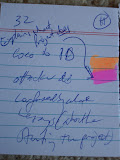


That's nice, you say, but what does it all mean? Well, each card has a sentence on it (roughly; work with me here ;)) that corresponds to a scene. The letter in the circle at the top right of each card is the POV; the green stripe or lack thereof at the top left indicates to me which timeline the card is in (past, present or future). The colours down the right hand side indicate which plot threads the scene relates to, selected from the following:

Don't know if you can read that or not, but it basically says pink is developing sympathy for the girl, blue is solving the mystery (the main thrust of the story), yellow is revealing past events, orange is a third party subplot, and purple is 'Angela', the second POV character.
So, why did I go to all the effort of writing this down on cards, and colour-coding, etc? Isn't that an awful lot of work for something that - again - may not survive first contact?
Well, yes... But no. Writing out the outline like this* has lots of advantages. Firstly, there's the visual aspect - you can see everything at once, all out in front of you, and it's dead easy to pick up the cards and shuffle them around and see what happens to your timeline - and your story. All sorts of connections can be formed that you'd never have found otherwise.
Secondly, you can immediately identify the weak spots in the plot: sentences that drag, that have no conflict, or that are just plain boring are usually indicative of scenes that do the same. Conflict is the meat of any writing, and this is a quick way to spot places you might be lacking.
Thirdly, the whole colour-coordination thing: subplots. Unless you're writing YA, MG, or really short books, you absolutely need subplots. My current wip, Jesscapades, has no less than 11 plot strands at present. And the easiest way I've found to keep track of them all is colour coding. Once again, it's a visual thing: you can see it all there in front of you, and you can tell at a glance how much of the book is devoted to which plot threads, places where perhaps you've ignored a thread for too long, and places where you might be able to introduce a new one - or even ways which you can combine threads if you have too many for the book you're writing. It's also a great way to make sure you've tied up all your threads. That's what the big black dot on card 35 above means: I've tied off plot threads pink and purple.
Not everyone likes outlining, and most outlines end up looking nothing like the finished book. But that doesn't mean there's no use for them, as I hope I've demonstrated. And not only can you use this to do a check of how you're going, getting the cards out and shuffling them around can be a great way to unstick yourself if the story feels like it's getting out of hand; a handful of white squares seems so much more manageable than nebulous story concepts colliding in your head.
So, do you outline? Why or why not? How far do you go? And would you ever consider this method?
* If you're a pantser, who absolutely cannot outline before writing, consider using this method for editing and revising instead. If you're an outliner, you can use this method then too.
Firstly, following: I'm sure a lot of you are aware, but blogger has developed this nifty little concept called 'following', whereby you can elect to follow a blog and thence have it appear on your blogger dashboard, conveniently letting you check all blogs you're following at once, and see at a glance who's updated and who hasn't. Consider this your official *poke* to FOLLOW MEEEEEEE! :) There's a handy link over there in the sidebar, right below Works In Progress, if you'd like to become a follower.
(As an aside, don't you just love how secret-cult-shall-rule-the-world that sounds? Hello, everyone, this is my blog, and these are my followers......)
Next, weather. This is completely unrelated to the blog, but it's just so jolly unfair I feel compelled to mention it. I live in Australia. AUS-TRA-LI-A. It is November. NO-VEM-BER. This, dear weather gods, means it's nearly Summer. This is NOT the appropriate time to start dumping the best snow of the year. \:|
Right. Which brings me to outlines, and the following of them :D As every tactician knows, no plan survives first contact with the enemy; and as every writer knows, no outline survives first contact with the story.
When I started writing The Project, I had a vague idea of where it was going, and that was all. It didn't matter too much: the entire object of writing it was an exercise in plot, in learning to race from one troublesome situation to whatever problem my muse came up with next. But there came a point when the time travel and multiple subplots got the better of me, and I outlined. Just one sentence per scene, in a pretty little table in a word document.
It was good enough to get me through to over halfway, but naturally, it couldn't remain intact. So, when I decided to start rewriting TP in order to get the characters right, since I knew the plot and twists etc, I broke out my outlining tools to give the book a bit more oomph, and to make sure I had everything covered. Hence, it's my weathered outline ;) It's weathered the storm of most of a first draft, and is still a bit rough (weathered, ha ha) around the edges! Gwa! *is proud of puns* O:)
This is the complete outline:

Yeah, I know, you can't see a thing. If you could, though, what you'd see would be something like this:


That's nice, you say, but what does it all mean? Well, each card has a sentence on it (roughly; work with me here ;)) that corresponds to a scene. The letter in the circle at the top right of each card is the POV; the green stripe or lack thereof at the top left indicates to me which timeline the card is in (past, present or future). The colours down the right hand side indicate which plot threads the scene relates to, selected from the following:

Don't know if you can read that or not, but it basically says pink is developing sympathy for the girl, blue is solving the mystery (the main thrust of the story), yellow is revealing past events, orange is a third party subplot, and purple is 'Angela', the second POV character.
So, why did I go to all the effort of writing this down on cards, and colour-coding, etc? Isn't that an awful lot of work for something that - again - may not survive first contact?
Well, yes... But no. Writing out the outline like this* has lots of advantages. Firstly, there's the visual aspect - you can see everything at once, all out in front of you, and it's dead easy to pick up the cards and shuffle them around and see what happens to your timeline - and your story. All sorts of connections can be formed that you'd never have found otherwise.
Secondly, you can immediately identify the weak spots in the plot: sentences that drag, that have no conflict, or that are just plain boring are usually indicative of scenes that do the same. Conflict is the meat of any writing, and this is a quick way to spot places you might be lacking.
Thirdly, the whole colour-coordination thing: subplots. Unless you're writing YA, MG, or really short books, you absolutely need subplots. My current wip, Jesscapades, has no less than 11 plot strands at present. And the easiest way I've found to keep track of them all is colour coding. Once again, it's a visual thing: you can see it all there in front of you, and you can tell at a glance how much of the book is devoted to which plot threads, places where perhaps you've ignored a thread for too long, and places where you might be able to introduce a new one - or even ways which you can combine threads if you have too many for the book you're writing. It's also a great way to make sure you've tied up all your threads. That's what the big black dot on card 35 above means: I've tied off plot threads pink and purple.
Not everyone likes outlining, and most outlines end up looking nothing like the finished book. But that doesn't mean there's no use for them, as I hope I've demonstrated. And not only can you use this to do a check of how you're going, getting the cards out and shuffling them around can be a great way to unstick yourself if the story feels like it's getting out of hand; a handful of white squares seems so much more manageable than nebulous story concepts colliding in your head.
So, do you outline? Why or why not? How far do you go? And would you ever consider this method?
* If you're a pantser, who absolutely cannot outline before writing, consider using this method for editing and revising instead. If you're an outliner, you can use this method then too.
29 October 2008
That Which Matters
A couple of days ago Wulf published an awesome post called 'What The Hell Are You Writing?' Fluff, or something that will last? In the comments, Merc asked how it is that you do this, how you make your work mean something, and give it themes and depth weight. She noted that there seems to be this gulf, between what we want to do, and what we actually do... But that it nonetheless seems something worth striving towards.
This is my response.
What do you think? Do you write 'fluff'? Are you happy writing fluff? Or do you strive for something more out of your writing? Something that might just change lives and leave the world a better place?
This is my response.
And in the end, striving is what counts.
You do it, I think, in the end, by caring. You care what happens, you care about knowing… You dare to ask the questions you don’t know the answers to, to bare your soul, to inject something that means something to you into your work, even though people might hate it, and by extension you…
I think that this is one of those cases where wanting, trying - this is enough. There will always be a disconnect. You can never move yourself like others can move you, because you see the imperfections, you read behind the lines and find the blood and sweat and tears… But if you’re trying, genuinely trying… That, in the end, is what counts.
What do you think? Do you write 'fluff'? Are you happy writing fluff? Or do you strive for something more out of your writing? Something that might just change lives and leave the world a better place?
19 September 2008
Story Elements #5: Themes
Theme. It's a pretty heavy word, and one that a lot of people shy away from. Given the theme-bashing that goes on in most highschool English courses, I dont blame them (says she, training to be a highschool English teacher).
But just because you got sick of some teacher drilling it into you that no, that's not what that book is about, THIS is it's theme - yes, even though that book is fun to read, we have to think about what it means... All this does not give you an excuse to ignore themes, especially in your own work.
Let's take a quick look at the definition of a theme (from Princeton and East Long Meadow).
* The subject matter of a conversation or discussion;
* A unifying idea that is a recurrent element in literary or artistic work;
* A central idea or abstract concept that is made concrete through representation in person, action, and image.
For writers, though, I think the most important thing to remember is that what you think the theme is, they way you write and read the book, is not what the New York Times or even a highschool English class might decide your theme is. Themes are intensely personal.
Of course, they have some general connectivity, too, otherwise we'd never agree on what a book meant, but at the bottom of it all, down in the nitty-gritty dirt of writing the book, the theme is personal.
The theme is you.
Put simply, the theme of the book is the part of it that resonates with you, the bit that gives it meaning - the bit where you actually feel like you're saying something, rather than just pushing characters around a page.
As you might be able to tell, I'm pretty keen on themes. Why is that, you ask? Because fun though fluff is to read, I decided long ago that the reason I was writing is because I had something to say. Now, please don't get me wrong here: I'm not in ANY way advocating preaching-through-fiction. That kind of book is terrible, unless you happen to already agree with it; nobody likes a missionary.
What I AM saying is that for me, personally, I have to feel like the book is important. I have to feel like I'm in there somewhere, and there has to be some part of it that I connect with, appreciate, agree with.
So, how can you find your themes, and once you've found them, how do you put them into your writing?
Two easy steps - and if you can get your Internal Editor out of the way, they really are not only easy, but FUN.
First of all, brainstorm. What matters to you? What is it in life that counts? What makes you mad, drives you insane, delights you, restores your faith in humanity, intrigues you, confuses you, sends you into the depths of despair? There are absolutely no right or wrong answers to this, because it's personal. Please, I beg you with everything I have, do not censor yourself when you do this. If you do, you'll end up with only the themes that your editor has classed as 'safe', 'acceptable' - and how brightly you shine is a direct correlate of how much you risk.
You do want to shine, don't you?
Good. So, brainstorm in hand, we move on to step two. Though before we do it might be worth noting that my Sweet Spot Maps are exactly the brainstorm that I've just described, categorised into things I hate, love, fear, get shivers from, am drawn to and need.
Steo Two: give theses things to your characters. You love thunderstorms? Great - so does your MC. Scared of ghosts? That's what your MC has to confront. These two aren't so much themes, but you can do it with themes too:
Watching corporations exploit the poor gets your blood boiling? Great. Your MC's battle is against a multi-national corporation and her goal is to save the poor village where she works. Scared of your own dark side, of what you could do if ever you got really angry? Fabulous. Your MC is pushed right over the edge and either surprises herself, or lives her worse nightmare and has to face the consequences.
But hold on, I hear you cry. Those aren't themes, they're plot elements!
To which I smile. Yes, they are. But they're plot elements that create themes, and more importantly, themes which you can believe in. Thunderstorms maybe not (though you could extrapolate and go for symbolism: thunderstorms are wild, untameable, unpredicable. Is this your MC, or who they wish they were?), but let's take the multi-national corporation one. That gives you themes of exploitation, poverty, the little person against the big, individual against corporation and hence power, and possibly truth, lies and propaganda.
Themes are scary to a lot of people, and highschool English departments have a lot to answer for. But as a writer, themes are critical to your work - and not only do they not have to be scary, creating them can be downright fun. Stress less, and let your subconscious delve into the things that matter to you most - these are your themes.
But just because you got sick of some teacher drilling it into you that no, that's not what that book is about, THIS is it's theme - yes, even though that book is fun to read, we have to think about what it means... All this does not give you an excuse to ignore themes, especially in your own work.
Let's take a quick look at the definition of a theme (from Princeton and East Long Meadow).
* The subject matter of a conversation or discussion;
* A unifying idea that is a recurrent element in literary or artistic work;
* A central idea or abstract concept that is made concrete through representation in person, action, and image.
For writers, though, I think the most important thing to remember is that what you think the theme is, they way you write and read the book, is not what the New York Times or even a highschool English class might decide your theme is. Themes are intensely personal.
Of course, they have some general connectivity, too, otherwise we'd never agree on what a book meant, but at the bottom of it all, down in the nitty-gritty dirt of writing the book, the theme is personal.
The theme is you.
Put simply, the theme of the book is the part of it that resonates with you, the bit that gives it meaning - the bit where you actually feel like you're saying something, rather than just pushing characters around a page.
As you might be able to tell, I'm pretty keen on themes. Why is that, you ask? Because fun though fluff is to read, I decided long ago that the reason I was writing is because I had something to say. Now, please don't get me wrong here: I'm not in ANY way advocating preaching-through-fiction. That kind of book is terrible, unless you happen to already agree with it; nobody likes a missionary.
What I AM saying is that for me, personally, I have to feel like the book is important. I have to feel like I'm in there somewhere, and there has to be some part of it that I connect with, appreciate, agree with.
So, how can you find your themes, and once you've found them, how do you put them into your writing?
Two easy steps - and if you can get your Internal Editor out of the way, they really are not only easy, but FUN.
First of all, brainstorm. What matters to you? What is it in life that counts? What makes you mad, drives you insane, delights you, restores your faith in humanity, intrigues you, confuses you, sends you into the depths of despair? There are absolutely no right or wrong answers to this, because it's personal. Please, I beg you with everything I have, do not censor yourself when you do this. If you do, you'll end up with only the themes that your editor has classed as 'safe', 'acceptable' - and how brightly you shine is a direct correlate of how much you risk.
You do want to shine, don't you?
Good. So, brainstorm in hand, we move on to step two. Though before we do it might be worth noting that my Sweet Spot Maps are exactly the brainstorm that I've just described, categorised into things I hate, love, fear, get shivers from, am drawn to and need.
Steo Two: give theses things to your characters. You love thunderstorms? Great - so does your MC. Scared of ghosts? That's what your MC has to confront. These two aren't so much themes, but you can do it with themes too:
Watching corporations exploit the poor gets your blood boiling? Great. Your MC's battle is against a multi-national corporation and her goal is to save the poor village where she works. Scared of your own dark side, of what you could do if ever you got really angry? Fabulous. Your MC is pushed right over the edge and either surprises herself, or lives her worse nightmare and has to face the consequences.
But hold on, I hear you cry. Those aren't themes, they're plot elements!
To which I smile. Yes, they are. But they're plot elements that create themes, and more importantly, themes which you can believe in. Thunderstorms maybe not (though you could extrapolate and go for symbolism: thunderstorms are wild, untameable, unpredicable. Is this your MC, or who they wish they were?), but let's take the multi-national corporation one. That gives you themes of exploitation, poverty, the little person against the big, individual against corporation and hence power, and possibly truth, lies and propaganda.
Themes are scary to a lot of people, and highschool English departments have a lot to answer for. But as a writer, themes are critical to your work - and not only do they not have to be scary, creating them can be downright fun. Stress less, and let your subconscious delve into the things that matter to you most - these are your themes.
Subscribe to:
Posts (Atom)
