Don't forget to enter the contest to win a copy of Michelle Davidson Argyle's awesome debut, Monarch.
For me, anyway, because people are all inspired by different things :)
1) Have other stuff that absolutely MUST be done in order for life to keep functioning. The more boring the better. Marking is perfect. (Writing as procrastination, #ftw!)
2) Read. Read lots. Read good books (so you can weep over how great you’ll never be). Read bad books (so you can gain confidence in knowing you can do better).
3) Collect random trivia (because you never know when the knowledge that a particular species of fungus turns ants into mind-controlled zombies might be useful).
4) Collect random images (because turning pretty I-wish-I’d-made-that images into words doesn’t count as plagiarism).
5) Play (because your muse, or imagination, or whatever term you like to use, is really just the grown-up term for your inner five-year-old).
Incidentally, my inner five-year-old is actually very determined that she’s an inner-six-but-NEARLY-SEVEN-year-old, and her name is Sarah, and she has brown pigtails and likes to wear white and pink, and lives in a bedroom with a white-painted cast-iron bed (the kind with rails down one side so it can pretend to be a chair, and gold caps on the four corner posts), a white bookcase and desk, pinky-red carpet and a large primary-coloured rug somewhere deep down in my right brain.
The sad thing is, I’m not even kidding, and I could draw you a picture of her, and then move on to draw pictures of my left brain (twenty-year-old university newspaper editor) and my hind brain (who bizarrely insists on being thirty-five and wearing an emerald-green satin formal gown) also.
I always knew I had issues. O.0 :P :D
Showing posts with label the muse. Show all posts
Showing posts with label the muse. Show all posts
20 October 2011

28 September 2010
Wait, This Was Supposed to be FUN?
Yeah. The title pretty much sums up writing at the moment. I realised yesterday as I was brainstorming post ideas - which, by the way, always come to me fully formed whenever I am away from paper, and then by the time I have paper brain has decided that no, post was written, did not need to remember it, and I procrastinate for hours/days/weeks from blogging trying to recall The Great Post That Was - hang on, I started a sentence way back up there.
*ahem*
Right. I realised yesterday that writing hasn't felt like fun - at all, not the tiniest bit - since I finished Sanctuary waaay back at Easter. This, ladies, gentlemen and alternatives, is Not a Good Thing. Not At All. In fact, it is So Bad, it makes me Resort To Capitals for Unimportant Things. See? Bad.
There's an easy solution, though: write something for the fun of it! Because we all know it's important to have fun! Only, problem. The brain, she has been 'working' at writing for so long, the Muse is literally curled up asleep on a train to Mexico, bored out of my brain. Ah ha.
How do I know this? She left a postcard for me on her bed.
Yes, my Muse has a bed. Her name is Sarah, she likes pink and has brown pigtails, and mostly appears as a six year old girl. When she's pissed off at me, she's a 32-year-old woman in an emerald green evening gown with glossy, dark brown curls.
Yeah. Me, weird. But we knew that.
ANYway. Problem = muse gone. Something is lacking. I can't kickstart myself into doing something for fun. It seems... pointless. And hey, I know it isn't - but try telling the empty bedroom Sarah usually occupies that.
So I need to have fun with writing again. But I don't know how.
Anyone out there able to remind me??
PS This post by Natalie Whipple strikes me as relevant.
*ahem*
Right. I realised yesterday that writing hasn't felt like fun - at all, not the tiniest bit - since I finished Sanctuary waaay back at Easter. This, ladies, gentlemen and alternatives, is Not a Good Thing. Not At All. In fact, it is So Bad, it makes me Resort To Capitals for Unimportant Things. See? Bad.
There's an easy solution, though: write something for the fun of it! Because we all know it's important to have fun! Only, problem. The brain, she has been 'working' at writing for so long, the Muse is literally curled up asleep on a train to Mexico, bored out of my brain. Ah ha.
How do I know this? She left a postcard for me on her bed.
Yes, my Muse has a bed. Her name is Sarah, she likes pink and has brown pigtails, and mostly appears as a six year old girl. When she's pissed off at me, she's a 32-year-old woman in an emerald green evening gown with glossy, dark brown curls.
Yeah. Me, weird. But we knew that.
ANYway. Problem = muse gone. Something is lacking. I can't kickstart myself into doing something for fun. It seems... pointless. And hey, I know it isn't - but try telling the empty bedroom Sarah usually occupies that.
So I need to have fun with writing again. But I don't know how.
Anyone out there able to remind me??
PS This post by Natalie Whipple strikes me as relevant.


10 May 2010
Tools: How Different Stories Want To Be Written
Have you ever noticed that different stories seem to have different personalities? Not just in terms of subject matter or tone, because obviously that will differ depending on what you're writing about. I mean, rather, the different demands that stories will make of you as you're writing them - the different ways they come out, and the different ways they demand to be written.
Both of my successful NaNo novels so far have required being written in yWriter, a nifty little program that allows you to sort the story via scenes and chapters, and in which you can drag things around and reorder them with great ease.
The Hunter Hunted required a scene-by-scene outline that I typed into Excel, and used as a guide as I wrote the whole story out in Word.
Sanctuary refused any efforts to outline and insisted on being written one-and-a-half spaced in calibri font.
Jesscapades didn't care so much about the font, but needed a full, colour-coded outline in Excel, which was then copied into Word and each scene summary slowly replaced by the actual scene.
Different stories, different personalities, different requirements. Funny how that works.
One of my older stories, which has three plotlines, is insisting that I write the shorter of the plotlines (~20k) out in full first, and then insert it into the appropriate places as I write the rest. Currently, I'm thinking of beginning over on HNOT, and writing out all the scenes from one character's POV first, and then all the scenes from another POV, and so on, and then splicing them all together.
Why is this, do you think? Why do stories take on such a personality as we're writing them?
I think part of it for me is that my 'muse' gets bored easily - and writing every book the same way equates, for her, to boring. So we mix it up, and get different results from different processes - and now I'm really curious to know if other writers write like this, and also if this will continue. Will different stories always want to be written differently, or will I one (elusive) day discover the magic process that just Works for me, and that's how Novels Will Be Written?
You can probably tell I suspect the former ;)
But tell me - am I normal? Do you all write like this too? And what's been your most demanding novel, requiring that you write it in the most complicated way (like upside down hanging from a tree, for example)? I have one story that I can only seem to work on during thunderstorms!
I know. I'm crazy. The least you can do is reassure me that you are too ;) :D
Both of my successful NaNo novels so far have required being written in yWriter, a nifty little program that allows you to sort the story via scenes and chapters, and in which you can drag things around and reorder them with great ease.
The Hunter Hunted required a scene-by-scene outline that I typed into Excel, and used as a guide as I wrote the whole story out in Word.
Sanctuary refused any efforts to outline and insisted on being written one-and-a-half spaced in calibri font.
Jesscapades didn't care so much about the font, but needed a full, colour-coded outline in Excel, which was then copied into Word and each scene summary slowly replaced by the actual scene.
Different stories, different personalities, different requirements. Funny how that works.
One of my older stories, which has three plotlines, is insisting that I write the shorter of the plotlines (~20k) out in full first, and then insert it into the appropriate places as I write the rest. Currently, I'm thinking of beginning over on HNOT, and writing out all the scenes from one character's POV first, and then all the scenes from another POV, and so on, and then splicing them all together.
Why is this, do you think? Why do stories take on such a personality as we're writing them?
I think part of it for me is that my 'muse' gets bored easily - and writing every book the same way equates, for her, to boring. So we mix it up, and get different results from different processes - and now I'm really curious to know if other writers write like this, and also if this will continue. Will different stories always want to be written differently, or will I one (elusive) day discover the magic process that just Works for me, and that's how Novels Will Be Written?
You can probably tell I suspect the former ;)
But tell me - am I normal? Do you all write like this too? And what's been your most demanding novel, requiring that you write it in the most complicated way (like upside down hanging from a tree, for example)? I have one story that I can only seem to work on during thunderstorms!
I know. I'm crazy. The least you can do is reassure me that you are too ;) :D
01 January 2010
Christmas Repost: Left and Right, Editor and Muse
Reposted from May 19 2009. Updated to include video.
A little while ago a trend went through the writing blogosphere (as trends tend to do) for posts about one’s ‘Muse’. Belatedly, because what I taught in my creative writing class yesterday reminded me of it, I’m going to chip in with my own two cents ;)
There’s long been a theory that the two halves of your brain have different functions: generally, the right brain is typified as being the centre of creative impulse, of emotions and intuition and irrationality. The left, as the opposite, gets the job of being rational, logical, precise, mathematical, and has the ability to recognise patterns and so forth.
These days, the accuracy of this theory is beginning to be questioned as we learn more and more about neuroplasticity (the idea that your brain is ‘plastic’, or malleable, in terms of function: there’s no one-to-one relationship between area and function, because your brain can learn to perform any given function using any given part of the brain, if it needs to), but there’s still this basic concept ‘out there’ that people tend to be either right or left brain dominant, just like they tend to be left or right handed.
You’d expect, I suppose, writers to be predominantly right-brained: creative, intuitive, etc.
But here’s the thing: I firmly believe that you can’t be a really good writer without being in touch with both sides of your brain.
If you think about it, what I’m saying isn’t all that out-there. We discuss this concept as writers all the time – just in different terms.
For example, hands up who’s heard the term ‘muse’? Don’t you think the concept of the ‘muse’ – the creative impulse, who functions by instinct and spontaneity, who struggles with logic sometimes and is intensely intuitive – meshes nicely with ‘right brain’?
And what about the left brain? Well, who’s heard the term ‘inner editor’, or some such? People are pretty fond of personification, it seems; we even personify the different parts of our brain :D ;)
So we have a ‘muse’ and an ‘inner editor’, or a left and right brain for the more prosaic amongst us. Both of these ‘creatures’ can be right pains in the backside – the muse stubbornly refusing to reveal more of an idea, and the inner editor constantly criticising the ideas that we do get, both at their extremes resulting in writing paralysis – but both are intensely necessary to the writing process.
You can’t write both drafting and editing, and you can’t draft without imagination, nor edit without logic and an eye for detail.
Two halves: one whole.
Both may seem painful at times – but as writers it’s in our best interests to learn to work with them both – and most importantly, to learn how to switch between one and the other.
If you're interested, I highly recommend the following video, hosted by Alan Alda, which clearly demonstrates just how awesome the two sides of the brain are.
If the embedded video isn't working, try this link.
So – how about you? Do you personify your brain, or not?
A little while ago a trend went through the writing blogosphere (as trends tend to do) for posts about one’s ‘Muse’. Belatedly, because what I taught in my creative writing class yesterday reminded me of it, I’m going to chip in with my own two cents ;)
There’s long been a theory that the two halves of your brain have different functions: generally, the right brain is typified as being the centre of creative impulse, of emotions and intuition and irrationality. The left, as the opposite, gets the job of being rational, logical, precise, mathematical, and has the ability to recognise patterns and so forth.
These days, the accuracy of this theory is beginning to be questioned as we learn more and more about neuroplasticity (the idea that your brain is ‘plastic’, or malleable, in terms of function: there’s no one-to-one relationship between area and function, because your brain can learn to perform any given function using any given part of the brain, if it needs to), but there’s still this basic concept ‘out there’ that people tend to be either right or left brain dominant, just like they tend to be left or right handed.
You’d expect, I suppose, writers to be predominantly right-brained: creative, intuitive, etc.
But here’s the thing: I firmly believe that you can’t be a really good writer without being in touch with both sides of your brain.
If you think about it, what I’m saying isn’t all that out-there. We discuss this concept as writers all the time – just in different terms.
For example, hands up who’s heard the term ‘muse’? Don’t you think the concept of the ‘muse’ – the creative impulse, who functions by instinct and spontaneity, who struggles with logic sometimes and is intensely intuitive – meshes nicely with ‘right brain’?
And what about the left brain? Well, who’s heard the term ‘inner editor’, or some such? People are pretty fond of personification, it seems; we even personify the different parts of our brain :D ;)
So we have a ‘muse’ and an ‘inner editor’, or a left and right brain for the more prosaic amongst us. Both of these ‘creatures’ can be right pains in the backside – the muse stubbornly refusing to reveal more of an idea, and the inner editor constantly criticising the ideas that we do get, both at their extremes resulting in writing paralysis – but both are intensely necessary to the writing process.
You can’t write both drafting and editing, and you can’t draft without imagination, nor edit without logic and an eye for detail.
Two halves: one whole.
Both may seem painful at times – but as writers it’s in our best interests to learn to work with them both – and most importantly, to learn how to switch between one and the other.
If you're interested, I highly recommend the following video, hosted by Alan Alda, which clearly demonstrates just how awesome the two sides of the brain are.
If the embedded video isn't working, try this link.
So – how about you? Do you personify your brain, or not?
19 May 2009
Left and Right, Editor and Muse
This week's Secret Poll is up ;)
A little while ago a trend went through the writing blogosphere (as trends tend to do) for posts about one’s ‘Muse’. Belatedly, because what I taught in my creative writing class yesterday reminded me of it, I’m going to chip in with my own two cents ;)
There’s long been a theory that the two halves of your brain have different functions: generally, the right brain is typified as being the centre of creative impulse, of emotions and intuition and irrationality. The left, as the opposite, gets the job of being rational, logical, precise, mathematical, and has the ability to recognise patterns and so forth.
These days, the accuracy of this theory is beginning to be questioned as we learn more and more about neuroplasticity (the idea that your brain is ‘plastic’, or malleable, in terms of function: there’s no one-to-one relationship between area and function, because your brain can learn to perform any given function using any given part of the brain, if it needs to), but there’s still this basic concept ‘out there’ that people tend to be either right or left brain dominant, just like they tend to be left or right handed.
You’d expect, I suppose, writers to be predominantly right-brained: creative, intuitive, etc.
But here’s the thing: I firmly believe that you can’t be a really good writer without being in touch with both sides of your brain.
If you think about it, what I’m saying isn’t all that out-there. We discuss this concept as writers all the time – just in different terms.
For example, hands up who’s heard the term ‘muse’? Don’t you think the concept of the ‘muse’ – the creative impulse, who functions by instinct and spontaneity, who struggles with logic sometimes and is intensely intuitive – meshes nicely with ‘right brain’?
And what about the left brain? Well, who’s heard the term ‘inner editor’, or some such? People are pretty fond of personification, it seems; we even personify the different parts of our brain :D ;)
So we have a ‘muse’ and an ‘inner editor’, or a left and right brain for the more prosaic amongst us. Both of these ‘creatures’ can be right pains in the backside – the muse stubbornly refusing to reveal more of an idea, and the inner editor constantly criticising the ideas that we do get, both at their extremes resulting in writing paralysis – but both are intensely necessary to the writing process.
You can’t write both drafting and editing, and you can’t draft without imagination, nor edit without logic and an eye for detail.
Two halves: one whole.
Both may seem painful at times – but as writers it’s in our best interests to learn to work with them both – and most importantly, to learn how to switch between one and the other.
So – how about you? Do you personify your brain, or not?
A little while ago a trend went through the writing blogosphere (as trends tend to do) for posts about one’s ‘Muse’. Belatedly, because what I taught in my creative writing class yesterday reminded me of it, I’m going to chip in with my own two cents ;)
There’s long been a theory that the two halves of your brain have different functions: generally, the right brain is typified as being the centre of creative impulse, of emotions and intuition and irrationality. The left, as the opposite, gets the job of being rational, logical, precise, mathematical, and has the ability to recognise patterns and so forth.
These days, the accuracy of this theory is beginning to be questioned as we learn more and more about neuroplasticity (the idea that your brain is ‘plastic’, or malleable, in terms of function: there’s no one-to-one relationship between area and function, because your brain can learn to perform any given function using any given part of the brain, if it needs to), but there’s still this basic concept ‘out there’ that people tend to be either right or left brain dominant, just like they tend to be left or right handed.
You’d expect, I suppose, writers to be predominantly right-brained: creative, intuitive, etc.
But here’s the thing: I firmly believe that you can’t be a really good writer without being in touch with both sides of your brain.
If you think about it, what I’m saying isn’t all that out-there. We discuss this concept as writers all the time – just in different terms.
For example, hands up who’s heard the term ‘muse’? Don’t you think the concept of the ‘muse’ – the creative impulse, who functions by instinct and spontaneity, who struggles with logic sometimes and is intensely intuitive – meshes nicely with ‘right brain’?
And what about the left brain? Well, who’s heard the term ‘inner editor’, or some such? People are pretty fond of personification, it seems; we even personify the different parts of our brain :D ;)
So we have a ‘muse’ and an ‘inner editor’, or a left and right brain for the more prosaic amongst us. Both of these ‘creatures’ can be right pains in the backside – the muse stubbornly refusing to reveal more of an idea, and the inner editor constantly criticising the ideas that we do get, both at their extremes resulting in writing paralysis – but both are intensely necessary to the writing process.
You can’t write both drafting and editing, and you can’t draft without imagination, nor edit without logic and an eye for detail.
Two halves: one whole.
Both may seem painful at times – but as writers it’s in our best interests to learn to work with them both – and most importantly, to learn how to switch between one and the other.
So – how about you? Do you personify your brain, or not?
29 January 2009
Why We Must Have Fun
Two Fridays ago, I made a promise to you that I would be back this week to contradict myself. Well, ta da!, here I am B-) In said post, I discussed the concept of your legacy - your body of work - and the importance of ensuring that everything in your legacy is worthy of being there. I threw around a few ways to tell if the book you're writing is the book for you, and talked about the importance of having an aim, and streamlining all your work towards that.
Today, I'm going to talk about the opposite: the importance of having fun. But before I do that, I wanted to address something that Merc said in the comments of that original post. Having a legacy, having a body of work, and being aware that any book you write could be a reader's first introduction to you, does not mean that you must be restricted to one genre. It just means that, like any other aspect of your writing career, the concept must be duplicated. When you try to build a career across multiple genres, what you're actually doing is building multiple careers. I tried to track down some articles on this topic that I've read written by both prominent authors and by agents, but alack, they all elude me at this moment. So you'll just have to trust me.
You can create a legacy across multiple genres. But what you're doing is creating a family of legacies, held together by their relationship to you - not a single, unified body of work.
Now, fun.
If the entire point of writing is to create your body of work, and if, as I suggested last time, any work you do that won't directly contribute to said body of work is a waste of time, then why am I now suggesting that it's necessary to do so?
Because sometimes, wasting time is necessary.
Writing is both a creative and a rational process: the first draft is usually where the right brain (the creative brain, a la your muse) has the most say, and the final edit belongs to your left brain (inner editor, anyone?). Creating a working relationship between both halves of your brain is vital if you want to survive the writing process (and another reason why I adore the Think Sideways course, with its strong emphasis on creating this connection), and a working relationship has to be about give and take, and compromise.
In the first draft, you have to teach your left brain to compromise. The words will be rough, the ideas half-formed, and plot holes will abound to a greater or lesser extent. This irritates your left brain to no end, and can escalate to the death-grip of perfectionism that results in Isuckitis - that terrible feeling you get when you just 'know' that you can't write, that everything you write is terrible, and so on, and so forth. This process is, sadly, pretty much part and parcel with writing: the book you're writing can be the best book in the world, and you know what? Inevitably, you will still hate it. At some point. For some reason. You will.
It even happens to the pros, and it's for that reason that the gist of Neil Gaiman's pep talk for NaNoWriMo in 2007 is forever etched upon my heart. Even the pros melt down. Even the pros hate their work. It's okay. It's normal. You'll get through it.
Which is precisely why play is important: if Isuckitis is brought on by drifting too far into your left brain and allowing perfectionism to take charge, then it must be cured by restoring the balance between your brain halves. Which means you need to do some serious right-brain work.
Just so you know, those two words - 'right-brain' and 'work' - don't actually go together. Your left brain works. Your right brain plays.
So what is play?
Play is letting your non-verbal, creative, irrational, impulsive right brain take control for a while. It's sitting down and creating something for the sheer joy of creating, without deadlines or requirements or self-styled impositions that it Must Be Good. Play is having fun. It's letting the muse out of the bag and letting stretch its legs, writing purely and simply Because You Can.
So play is important, because it rebalances you - and it connects your brain halves back together. For those few non-writers who read this blog, let me assure you that this concept applies equally to anything you do in life. I firmly believe that humans are supposed to be both-brained; that is, we're designed to have a balance of both parts of ourselves: some rationality, some forethought and planning, and some impulse, creativity, and carefreeness.
Our society places a lot of emphasis on the left brain. But it's our job as writers to utilise both, and perhaps even remind people that balance is a good thing after all. So go. Play for a while, and reconnect with yourself.
:)
03 December 2008
Lacemaking
Just quickly before we get to the meat of the post, I have a new sister-site to this one wherein I'll be putting together extras for the novels I'm working on: character photos, maps, blurbs, and the like. The link is on the homepost above - you'll need to either email me or leave a comment with your email address to ask for an invitation.
So, because of the lovely Wall of Life that's slammed into me over the beginning of this week, I'm not convinced this post applies anymore.
Well, actually, that's not true. The sentiment still applies. I'm just lacking the motivation to weave further ;)
What am I talking about?
Jesscapades, actually. You see, the way I write best is to write act one on the fly, by the seat of my pants, with naught but a vague impression of what the ending will be. And then, inevitably, I hit a wall, and must stop to outline.
Interestingly, that wall appears to be not so inevitable. With Jesscapades, I haven't hit it. Well, I've hit a wall of sorts, but that's more health-and-energy related than reaching a point in the novel where I need to start plotting.
And, oddly enough, Jesscapades is at least as complex as TBAEO, and much more so than The Project. At last count, there were about 12 'plot threads'.
Plot threads. The term got me thinking, and all of a sudden I had this image in my head of me, my hands, holding all these threads together, completely unsure of how they were going to play out, but content with the knowledge that I was holding them - was still in control. The muse does the weaving, I do the watching. It's a fascinating and creative process, and it reminds me of lacemaking.
Have you ever seen anyone make lace? If you haven't, there's a cool picture of the process here. And that's pretty much what I feel like with Jesscapades: at a glance, it looks like a tangled mess, with threads going everywhere, splaying out in all directions. But if I look carefully, I can see something pretty in all that I've done - some semblance of a pattern coming to life, tying the wayward threads into each other and creating a story.
Do you ever have moments like that, where you just get this sense that the story will turn out all right, even if you don't know exactly where it's going? Do you ever feel like that with life?
So, because of the lovely Wall of Life that's slammed into me over the beginning of this week, I'm not convinced this post applies anymore.
Well, actually, that's not true. The sentiment still applies. I'm just lacking the motivation to weave further ;)
What am I talking about?
Jesscapades, actually. You see, the way I write best is to write act one on the fly, by the seat of my pants, with naught but a vague impression of what the ending will be. And then, inevitably, I hit a wall, and must stop to outline.
Interestingly, that wall appears to be not so inevitable. With Jesscapades, I haven't hit it. Well, I've hit a wall of sorts, but that's more health-and-energy related than reaching a point in the novel where I need to start plotting.
And, oddly enough, Jesscapades is at least as complex as TBAEO, and much more so than The Project. At last count, there were about 12 'plot threads'.
Plot threads. The term got me thinking, and all of a sudden I had this image in my head of me, my hands, holding all these threads together, completely unsure of how they were going to play out, but content with the knowledge that I was holding them - was still in control. The muse does the weaving, I do the watching. It's a fascinating and creative process, and it reminds me of lacemaking.
Have you ever seen anyone make lace? If you haven't, there's a cool picture of the process here. And that's pretty much what I feel like with Jesscapades: at a glance, it looks like a tangled mess, with threads going everywhere, splaying out in all directions. But if I look carefully, I can see something pretty in all that I've done - some semblance of a pattern coming to life, tying the wayward threads into each other and creating a story.
Do you ever have moments like that, where you just get this sense that the story will turn out all right, even if you don't know exactly where it's going? Do you ever feel like that with life?
05 November 2008
NaNoWriMo, Round the First
...In slightly unrelated news, I've finally finished chemistry - for good. This is a highly squee-worthy thing. Trust me.
Right. Nano.
As we all know, no battle plan survives first contact with the enemy intact, and my Nano plans are no exception. Recall, if you will, that my primary focus was to be Sanctuary, the MG fantasy novel, and that I intended to include assessment and possibly rewrites of TP in my Nano word count.
Ha. Funny.
First of all, I now have the opening to the first three books in the Edge & Gem series: Sanctuary, Finding Abbi, and The Danger Roads. This consumed me for quite a while as I struggled back and forth between them, trying to get the respective voices right, and getting over the fact that all three books, while centering on Edge, are from completely different POVs. However, I think I've finally settled down on Sanctuary, and will leave the other books for later. I have about 2.5k on the story so far.
Word count: well, if I include assessment etc, my word count is 7k+. If I don't, it's a hair short of 6k. Looking at my progress from last year, as of yesterday (the 4th) I was at approximately the same place. Last year, I had a run of about 4 days where I didn't write at all, between about the 10th and 14th; so if I can't write for the rest of this week due to exams etc, I don't think it matters. I'm pretty confident that I can get to the 50k without having to cheat by using things like assessment and TP rewrites. This is unexpectedly pleasant :)
The final surprise is that Jesscapades has taken off. I have about 3k of it so far, and even though it terrifies me because I have no plot, I'm really excited about it. (Not that, come to think of it, I have a plot for Sanctuary either :S *terror, terror*). The bad guys have show up as POV characters, there's intrigue everywhere you look and nothing is as it seems, and the Muse is firing on all cylinders. It's very exciting.
I've also done a bit of random stuff here and there, in between assessment, which has bumped my overall wordcount up a bit. I'm looking forward to next Monday, when all the stressful part of uni will be over and I can get serious about writing. For now though, back to work, and essays :S Blech!
:)
Right. Nano.
As we all know, no battle plan survives first contact with the enemy intact, and my Nano plans are no exception. Recall, if you will, that my primary focus was to be Sanctuary, the MG fantasy novel, and that I intended to include assessment and possibly rewrites of TP in my Nano word count.
Ha. Funny.
First of all, I now have the opening to the first three books in the Edge & Gem series: Sanctuary, Finding Abbi, and The Danger Roads. This consumed me for quite a while as I struggled back and forth between them, trying to get the respective voices right, and getting over the fact that all three books, while centering on Edge, are from completely different POVs. However, I think I've finally settled down on Sanctuary, and will leave the other books for later. I have about 2.5k on the story so far.
Word count: well, if I include assessment etc, my word count is 7k+. If I don't, it's a hair short of 6k. Looking at my progress from last year, as of yesterday (the 4th) I was at approximately the same place. Last year, I had a run of about 4 days where I didn't write at all, between about the 10th and 14th; so if I can't write for the rest of this week due to exams etc, I don't think it matters. I'm pretty confident that I can get to the 50k without having to cheat by using things like assessment and TP rewrites. This is unexpectedly pleasant :)
The final surprise is that Jesscapades has taken off. I have about 3k of it so far, and even though it terrifies me because I have no plot, I'm really excited about it. (Not that, come to think of it, I have a plot for Sanctuary either :S *terror, terror*). The bad guys have show up as POV characters, there's intrigue everywhere you look and nothing is as it seems, and the Muse is firing on all cylinders. It's very exciting.
I've also done a bit of random stuff here and there, in between assessment, which has bumped my overall wordcount up a bit. I'm looking forward to next Monday, when all the stressful part of uni will be over and I can get serious about writing. For now though, back to work, and essays :S Blech!
:)
19 September 2008
Story Elements #5: Themes
Theme. It's a pretty heavy word, and one that a lot of people shy away from. Given the theme-bashing that goes on in most highschool English courses, I dont blame them (says she, training to be a highschool English teacher).
But just because you got sick of some teacher drilling it into you that no, that's not what that book is about, THIS is it's theme - yes, even though that book is fun to read, we have to think about what it means... All this does not give you an excuse to ignore themes, especially in your own work.
Let's take a quick look at the definition of a theme (from Princeton and East Long Meadow).
* The subject matter of a conversation or discussion;
* A unifying idea that is a recurrent element in literary or artistic work;
* A central idea or abstract concept that is made concrete through representation in person, action, and image.
For writers, though, I think the most important thing to remember is that what you think the theme is, they way you write and read the book, is not what the New York Times or even a highschool English class might decide your theme is. Themes are intensely personal.
Of course, they have some general connectivity, too, otherwise we'd never agree on what a book meant, but at the bottom of it all, down in the nitty-gritty dirt of writing the book, the theme is personal.
The theme is you.
Put simply, the theme of the book is the part of it that resonates with you, the bit that gives it meaning - the bit where you actually feel like you're saying something, rather than just pushing characters around a page.
As you might be able to tell, I'm pretty keen on themes. Why is that, you ask? Because fun though fluff is to read, I decided long ago that the reason I was writing is because I had something to say. Now, please don't get me wrong here: I'm not in ANY way advocating preaching-through-fiction. That kind of book is terrible, unless you happen to already agree with it; nobody likes a missionary.
What I AM saying is that for me, personally, I have to feel like the book is important. I have to feel like I'm in there somewhere, and there has to be some part of it that I connect with, appreciate, agree with.
So, how can you find your themes, and once you've found them, how do you put them into your writing?
Two easy steps - and if you can get your Internal Editor out of the way, they really are not only easy, but FUN.
First of all, brainstorm. What matters to you? What is it in life that counts? What makes you mad, drives you insane, delights you, restores your faith in humanity, intrigues you, confuses you, sends you into the depths of despair? There are absolutely no right or wrong answers to this, because it's personal. Please, I beg you with everything I have, do not censor yourself when you do this. If you do, you'll end up with only the themes that your editor has classed as 'safe', 'acceptable' - and how brightly you shine is a direct correlate of how much you risk.
You do want to shine, don't you?
Good. So, brainstorm in hand, we move on to step two. Though before we do it might be worth noting that my Sweet Spot Maps are exactly the brainstorm that I've just described, categorised into things I hate, love, fear, get shivers from, am drawn to and need.
Steo Two: give theses things to your characters. You love thunderstorms? Great - so does your MC. Scared of ghosts? That's what your MC has to confront. These two aren't so much themes, but you can do it with themes too:
Watching corporations exploit the poor gets your blood boiling? Great. Your MC's battle is against a multi-national corporation and her goal is to save the poor village where she works. Scared of your own dark side, of what you could do if ever you got really angry? Fabulous. Your MC is pushed right over the edge and either surprises herself, or lives her worse nightmare and has to face the consequences.
But hold on, I hear you cry. Those aren't themes, they're plot elements!
To which I smile. Yes, they are. But they're plot elements that create themes, and more importantly, themes which you can believe in. Thunderstorms maybe not (though you could extrapolate and go for symbolism: thunderstorms are wild, untameable, unpredicable. Is this your MC, or who they wish they were?), but let's take the multi-national corporation one. That gives you themes of exploitation, poverty, the little person against the big, individual against corporation and hence power, and possibly truth, lies and propaganda.
Themes are scary to a lot of people, and highschool English departments have a lot to answer for. But as a writer, themes are critical to your work - and not only do they not have to be scary, creating them can be downright fun. Stress less, and let your subconscious delve into the things that matter to you most - these are your themes.
But just because you got sick of some teacher drilling it into you that no, that's not what that book is about, THIS is it's theme - yes, even though that book is fun to read, we have to think about what it means... All this does not give you an excuse to ignore themes, especially in your own work.
Let's take a quick look at the definition of a theme (from Princeton and East Long Meadow).
* The subject matter of a conversation or discussion;
* A unifying idea that is a recurrent element in literary or artistic work;
* A central idea or abstract concept that is made concrete through representation in person, action, and image.
For writers, though, I think the most important thing to remember is that what you think the theme is, they way you write and read the book, is not what the New York Times or even a highschool English class might decide your theme is. Themes are intensely personal.
Of course, they have some general connectivity, too, otherwise we'd never agree on what a book meant, but at the bottom of it all, down in the nitty-gritty dirt of writing the book, the theme is personal.
The theme is you.
Put simply, the theme of the book is the part of it that resonates with you, the bit that gives it meaning - the bit where you actually feel like you're saying something, rather than just pushing characters around a page.
As you might be able to tell, I'm pretty keen on themes. Why is that, you ask? Because fun though fluff is to read, I decided long ago that the reason I was writing is because I had something to say. Now, please don't get me wrong here: I'm not in ANY way advocating preaching-through-fiction. That kind of book is terrible, unless you happen to already agree with it; nobody likes a missionary.
What I AM saying is that for me, personally, I have to feel like the book is important. I have to feel like I'm in there somewhere, and there has to be some part of it that I connect with, appreciate, agree with.
So, how can you find your themes, and once you've found them, how do you put them into your writing?
Two easy steps - and if you can get your Internal Editor out of the way, they really are not only easy, but FUN.
First of all, brainstorm. What matters to you? What is it in life that counts? What makes you mad, drives you insane, delights you, restores your faith in humanity, intrigues you, confuses you, sends you into the depths of despair? There are absolutely no right or wrong answers to this, because it's personal. Please, I beg you with everything I have, do not censor yourself when you do this. If you do, you'll end up with only the themes that your editor has classed as 'safe', 'acceptable' - and how brightly you shine is a direct correlate of how much you risk.
You do want to shine, don't you?
Good. So, brainstorm in hand, we move on to step two. Though before we do it might be worth noting that my Sweet Spot Maps are exactly the brainstorm that I've just described, categorised into things I hate, love, fear, get shivers from, am drawn to and need.
Steo Two: give theses things to your characters. You love thunderstorms? Great - so does your MC. Scared of ghosts? That's what your MC has to confront. These two aren't so much themes, but you can do it with themes too:
Watching corporations exploit the poor gets your blood boiling? Great. Your MC's battle is against a multi-national corporation and her goal is to save the poor village where she works. Scared of your own dark side, of what you could do if ever you got really angry? Fabulous. Your MC is pushed right over the edge and either surprises herself, or lives her worse nightmare and has to face the consequences.
But hold on, I hear you cry. Those aren't themes, they're plot elements!
To which I smile. Yes, they are. But they're plot elements that create themes, and more importantly, themes which you can believe in. Thunderstorms maybe not (though you could extrapolate and go for symbolism: thunderstorms are wild, untameable, unpredicable. Is this your MC, or who they wish they were?), but let's take the multi-national corporation one. That gives you themes of exploitation, poverty, the little person against the big, individual against corporation and hence power, and possibly truth, lies and propaganda.
Themes are scary to a lot of people, and highschool English departments have a lot to answer for. But as a writer, themes are critical to your work - and not only do they not have to be scary, creating them can be downright fun. Stress less, and let your subconscious delve into the things that matter to you most - these are your themes.
10 September 2008
Sweet Spot Map #2 - I Am Drawn To
Sorry it's taken so long to post this. I was sure I hadn't finished detangling the map yet, and haven't had time to do so, so have been putting it off - only to discover today that it's actually been sitting there on my computer, done!
So, here for your enjoyment is another part of my Sweet Spot Map - I Am Drawn To. Abstract 'drawn-to's' provide great fodder for themes. You can see things like 'truth' and 'belonging' on there, things which often make their way into my work. What is truth? How would this character feel if they had nowhere to belong? Places obviously make for fun settings: for me, high exposed places, dark streets, night settings, old ruins... all these make for shiny, shivery settings full of atmosphere. People nouns make great MCs (assassins and spies both show up on the more recent version of this map), other nouns are cool props to throw in or things which can generate conflict, and stuff like 'classifications' can be seen in a lot of my stories in the divisions of people in houses, clubs, groups, societies, year levels, and so on and so forth.

(Click on the map for a bigger version)
All in all, this map is providing me with fabulous inspiration, and what's more, it's helping me identify my themes - but more on that next week :)
So - what are some things that you're drawn to?
So, here for your enjoyment is another part of my Sweet Spot Map - I Am Drawn To. Abstract 'drawn-to's' provide great fodder for themes. You can see things like 'truth' and 'belonging' on there, things which often make their way into my work. What is truth? How would this character feel if they had nowhere to belong? Places obviously make for fun settings: for me, high exposed places, dark streets, night settings, old ruins... all these make for shiny, shivery settings full of atmosphere. People nouns make great MCs (assassins and spies both show up on the more recent version of this map), other nouns are cool props to throw in or things which can generate conflict, and stuff like 'classifications' can be seen in a lot of my stories in the divisions of people in houses, clubs, groups, societies, year levels, and so on and so forth.

(Click on the map for a bigger version)
All in all, this map is providing me with fabulous inspiration, and what's more, it's helping me identify my themes - but more on that next week :)
So - what are some things that you're drawn to?
01 September 2008
How To Think Sideways
Just a reminder that the How to Think Sideways course (see my review here) is on sale only through this link for this week. There's a new option, too -
You can sign up for the 6-month course, which is US$47 per month.
OR
You can now sign for the course extended over 12 months, which means you're only paying US$23.50 per month.
Obviously it's the same amount total, but as a student I can appreciate that $23.50 makes a much smaller dent in your monthly budget. And don't forget, you can drop out at any time and you will be fully refunded for any lessons in the month that you haven't received yet - meaning that it will cost you $11.75 to test out the course, download lesson one, and see you think it's for you.
Sales go live at 9am Eastern Daylight Time, through this link, and will be open for 7 days. Remember that if you buy through my link, I can offer you a %25 refund once it clears at the end of each month.
If you're wondering what the course covers, this is the curriculum:
Sideways Thinking: Ideas
Week 1: How to Break the Four "Thinking" Barriers to Your Success
Week 2: How to Discover Your Writing "Sweet Spot"
Week 3: How to Generate Ideas On a Deadline
Week 4: How to Recognize and Build On Good Ideas
Sideways Thinking: Project Planning
Week 5: How to Define Your Project's Needs
Week 6: How to Discover (or Create) Your Project's Market
Week 7: How to Develop Your Personal Project System
Week 8: How to Plan Your Project While NOT Killing Your Story
Sideways Thinking: First Chapters
Week 9: How to Write From Inside Your Story
Week 10: How to "Plan" Surprises that Surprise Even You
Week 11: How to Design Compelling Queries, Proposals, and Sample Chapters
Week 12: How to Create, Complicate, and Solve Problems
Sideways Thinking: Middles
Week 13: "Can't I Just Kill Them All?" How to Fall In Love With Your Project A Second Time
Week 14: How to Find and Use Your "Planned" Surprises
Week 15: How to "Hire" Spies, and Why Your Project Needs Them
Week 16: How to Assess Your Progress and Make Mid-Course Corrections
Sideways Thinking: Endings
Week 17: How to Work With Editors, Agents, Marketing Departments, and Artists, and Not Wreck Your Project.
Week 18: How to Find the RIGHT Ending
Week 19: How to Bend Your Plan Without Breaking It
Week 20: How to Write the Ending That Sells the Next Book
Sidways Thinking: Wrap Up/Start Again
Week 21: How to Plan Your Revision
Week 22: How to NOT Fix What Ain't Broken (While Still Fixing What Is)
Week 23v How to Deliver What You Promised and What They Want On Deadline
Week 24: How to NOT Be a One-Book Wonder---Learn to Produce Repeatable Results
How to Think Sideways: Career Survival Training for Writers.
You can sign up for the 6-month course, which is US$47 per month.
OR
You can now sign for the course extended over 12 months, which means you're only paying US$23.50 per month.
Obviously it's the same amount total, but as a student I can appreciate that $23.50 makes a much smaller dent in your monthly budget. And don't forget, you can drop out at any time and you will be fully refunded for any lessons in the month that you haven't received yet - meaning that it will cost you $11.75 to test out the course, download lesson one, and see you think it's for you.
Sales go live at 9am Eastern Daylight Time, through this link, and will be open for 7 days. Remember that if you buy through my link, I can offer you a %25 refund once it clears at the end of each month.
If you're wondering what the course covers, this is the curriculum:
Sideways Thinking: Ideas
Week 1: How to Break the Four "Thinking" Barriers to Your Success
Week 2: How to Discover Your Writing "Sweet Spot"
Week 3: How to Generate Ideas On a Deadline
Week 4: How to Recognize and Build On Good Ideas
Sideways Thinking: Project Planning
Week 5: How to Define Your Project's Needs
Week 6: How to Discover (or Create) Your Project's Market
Week 7: How to Develop Your Personal Project System
Week 8: How to Plan Your Project While NOT Killing Your Story
Sideways Thinking: First Chapters
Week 9: How to Write From Inside Your Story
Week 10: How to "Plan" Surprises that Surprise Even You
Week 11: How to Design Compelling Queries, Proposals, and Sample Chapters
Week 12: How to Create, Complicate, and Solve Problems
Sideways Thinking: Middles
Week 13: "Can't I Just Kill Them All?" How to Fall In Love With Your Project A Second Time
Week 14: How to Find and Use Your "Planned" Surprises
Week 15: How to "Hire" Spies, and Why Your Project Needs Them
Week 16: How to Assess Your Progress and Make Mid-Course Corrections
Sideways Thinking: Endings
Week 17: How to Work With Editors, Agents, Marketing Departments, and Artists, and Not Wreck Your Project.
Week 18: How to Find the RIGHT Ending
Week 19: How to Bend Your Plan Without Breaking It
Week 20: How to Write the Ending That Sells the Next Book
Sidways Thinking: Wrap Up/Start Again
Week 21: How to Plan Your Revision
Week 22: How to NOT Fix What Ain't Broken (While Still Fixing What Is)
Week 23v How to Deliver What You Promised and What They Want On Deadline
Week 24: How to NOT Be a One-Book Wonder---Learn to Produce Repeatable Results
How to Think Sideways: Career Survival Training for Writers.
23 August 2008
Month One: Think Sideways Review (Plus Some Goodies)
Warning: this post is loooooong.... O:)
I’ve been thinking a lot over the last week about how I wanted to write this – because I have been wanting to write it for the last week, but as you can see, uni has prevented me from posting much of anything :D One thing that I think is rather sad is that whenever anyone follows the words ‘This is really good...’ with the words ‘...and you should buy it!’, their motivations are immediately called into question. So I’m going to get the ‘deal’ bit of this review out of the way now, and then move on to the fun stuff – including a free pdf for you if you read all the way to the end :)
The Deal
Holly Lisle’s Think Sideways course is a brand new course that teaches ways to think sideways, and survive a writing career. The 300-seat first class sold out within three days, and that the second class isn’t going to open until the present one ends – aka, February.
However.
All students are automatically affiliate members, and while the program wasn’t going to open until the second class did (not much point otherwise, really), as it stands 4 people have had to drop out of the course for financial reasons.
So the affiliate program is opening early. Next Monday, Think Sideways will open for registrations through affiliate links only. This is where the deal comes in: should you decide that this sounds like something you want to try, and sign up through my link, I get a 50% commission on what you spend. If you let me know that you bought through my link and show me a copy of your receipt, I’ll send half of that 50% back to you when I get it (paid at the end of each month, I think). In effect, it means you get a 25% refund. That’s the deal. On to the review.
Cost
Hehe, the killer. When I was reading the pre-discussions of this course, I was all like – Squee!! This sounds so AWESOME!! But how much will it COST?? And of course, the price wasn’t released until the course went live, and it went live at 2am my time... Me, get up in the middle of the night to register for a writing course? Would I do a thing like that? O:) Heh, when it comes with the added bonus of not having to disclose the price to my DH until I’d already paid for it, you bet I would ;):D
Anyway, cost. The course is US$47 per month for 6 months. Payments are monthly only, via paypal. You get 4 lessons per month (actually 1 per week, so occasionally you’d get 5 in a month), which equates to something random like $11.50 per lesson. Not bad – but still not small change. What sold it for me was the refund policy: drop out of the course at any time and you’ll get a full refund for any lessons you haven’t yet received for the month. I figured worst case scenario I’d get lesson one and have to drop out, and the experience would have cost $12. Not so bad.
Fun Stuff – what I’ve learned
Ah. The rave section. :o) Honestly, I really do love this course to pieces, so if I end up raving, I’m very sorry *blush* :D
So. Month one. The month of learning to communicate with your Muse, aka your subconscious mind. Some of you, I expect will be familiar with the concept of brained-ness – people tend to be left brained (logical, rational, planned, etc) or right brained (creative, artistic, spontaneous, etc). But writing uses both sides of the brain. You have to think and plan and be logical, otherwise your story will have plot holes a mammoth could run through. But you have to use your right brain, too, to give your story heart and sparkle – to make it shine. And that’s what this first month of lessons has been about: learning to get both parts of your brain to communicate with each other, at will, on demand.
Lesson One begins with four barriers to ‘thinking’ and how to break them – the biggest one, for me, being perfectionism. I’d like to think I’m a recovering perfectionism, but when I’m in the grips of a first draft, and the story is beginning to spiral off track and I hate everything I’ve written and everything I’m going to write... Or when I’m mid-edits for the fifth time on a story and still can’t get it write... Yeah. Perfectionism rears its ugly head. So, this is an introductory lesson, but it also includes techniques for breaking your thinking barriers, and setting yourself up for successful communication – with yourself :D
Lesson Two. I’d like to say this has been my favourite lesson, but the others are cool too :o) It’s certainly awesome, though. This is the lesson that introduces the concept of a Sweet Spot Map, a map created by your unconscious that directs you towards the heart of your writing. You can pull stuff of this map and shove it into any story, in any genre, and still be guaranteed to love it. It’s a great tool for sad-but-occasionally-necessary changes of direction mid-career. For me, it’s just sheer FUN. My Muse adores this map so much that I quite literally never go anywhere without it, and am often pulling it out to add a word here or there. ‘The sound of glass shattering’ was today’s addition to ‘I love’. Yesterday I added ‘which triggers a DNA shift’ to ‘I get shivers from’. (No, I’m not entirely sure what it means :D That’s kinda the point, though). ‘Ocean’ showed up more than ten times, scattered variously between ‘I fear’, ‘I get shivers from’, and ‘I am drawn to’ :o)
Lesson Three is learning to call down lightning :D It’s about getting your muse to generate the good stuff on a deadline. The techniques in this lesson are so fabulous, I’m using them for everything and anything that I need input on from my tricksy subconscious. You set the parameters, and wait. Learning to trust that the muse knows what it’s doing has been hard, but I’m still practicing, and it’s generating more concrete ideas and plot twists and so forth for my current WIPs in a shorter time frame than I’ve ever gotten before :)
Lesson Four. Wow. I still can’t get over just how huge the impact of this lesson was. This is the lesson where you learn how to tell the bad ideas from the good, and the good from the great. In a way, many of you have been affected by this lesson already. Reading this lesson is what prompted me to re-evaluate my WIP list, ensuring that the ones that made the final cut were the ‘great’ ideas, not just the ‘good’. Re-evaluating my WIP list prompted a lot of my friends from Critique Circle to re-evaluate their WIP lists, shaving off the fat, trimming dead wood – weeding their great ideas from their ‘just okay’ ones. And they haven’t even read the lesson. In fact, most of them didn’t even know I had, or why I was evaluating my WIPs. And yet the content of this lesson was still conveyed to them. *shakes head* I’m still amazed :)
So there you have it. One month. Four lessons. The entire way I approach my writing changed. I’m proud of those stories that have made the final cut. I’m itching to write them, and I know I’m going to have a lot of fun doing so. But also, I can see something else that’s important: the final cut aren’t just a random collection of stories. They’re a body of work. A collection. They share similar themes and tones, issues and styles – they share me. I can see someone, in years to come, reading one of these books and going ‘Yep, that was a Laurens book.’ (Hopefully followed up by ‘and it was just as good as the rest of them’, of course :D)
To finish, the free pdf I mentioned J Holly has a newsletter where she answers questions that people email her, and last week someone happened to ask a question that Holly had just answered in a Think Sideways module – so she’s giving the module away for free J It’s Lesson Seven, which I’m not actually up to yet, so it’s new for me too. Reading over it, I like it, and I can see how it ties in to the continuum of the Think Sideways course – but it’s on character development, and some of you will already have a pretty firm handle on that. Mind you, I guess if I were Holly I wouldn’t be giving my best modules away for free either ;) Anyway, here it is :)
Congratulations and *cookies* for making it all the way to the end. You deserve a medal ;):D
09 August 2008
Sweet Spot Map
Instead of a series article as the third post for this week, I'm going to start something new - because we all know I can't cope unless I have too many things going at once :o)
Three weeks ago, I signed up for Holly Lisle's Think Sideways course. It's a six month online course, focusing on writing fiction with the aim of making a living from it - tips and tricks and strategies to get your career going and keep it going.
Three weeks into it, I'm loving it :)
As part of the course, we have weekly 'assignments', and a lot of people on the Think Sideways forums have been sharing their assignments for week two. I was kinda surprised, as well as interested and excited, in my own results, and I thought - where better to post them than here? :)
The assignment was to create a 'sweet spot map' - a random clustering of the first things that came to mind for each of six prompts: I love, I am drawn to, I get shivers from, I fear, I hate, I need. These are things that come (if you're really working 'randomly') from your subconscious, and are things that you can put into your writing no matter what genre you're writing in that will make it resonate with you; these are the things in your writing that are you.
I made my original map as recommended on six scrappy pieces of paper taped together - and I adore it, and am now carrying it everywhere with me, adding to it as things occur to me. However, for ease of viewing, I've used a nifty little program called Cayra, so that you won't have to decode my handwriting ;)
It's taking me a while to type the stuff in and detangle the resulting webby nets, so I'll pop the six maps up over the next few weeks. But first, for your viewing pleasure, an insight into what my subconscious - my dear little Muse *cough cough* - loves.
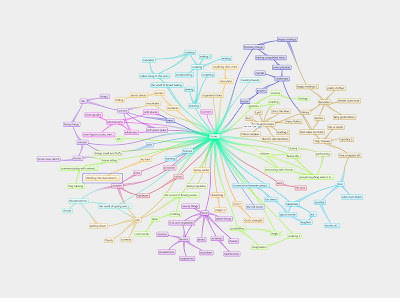
'Ears' and 'tails' were the items that amused me most :o) I have no IDEA what my muse is on about there - though I do have a propensity to greet close friends/family members by nibbling their ears while giving them a hello-hug, so maybe that explains ears??
And 'weather' I could have expanded on for hours... I adore weather. Food could have been expanded too, adding in more tasty goodness... But it was pretty cool to see what appeared :) This one's perhaps not as revealing as some of the other maps (I hate, I fear, I need), but it's fun nonetheless :)
Three weeks ago, I signed up for Holly Lisle's Think Sideways course. It's a six month online course, focusing on writing fiction with the aim of making a living from it - tips and tricks and strategies to get your career going and keep it going.
Three weeks into it, I'm loving it :)
As part of the course, we have weekly 'assignments', and a lot of people on the Think Sideways forums have been sharing their assignments for week two. I was kinda surprised, as well as interested and excited, in my own results, and I thought - where better to post them than here? :)
The assignment was to create a 'sweet spot map' - a random clustering of the first things that came to mind for each of six prompts: I love, I am drawn to, I get shivers from, I fear, I hate, I need. These are things that come (if you're really working 'randomly') from your subconscious, and are things that you can put into your writing no matter what genre you're writing in that will make it resonate with you; these are the things in your writing that are you.
I made my original map as recommended on six scrappy pieces of paper taped together - and I adore it, and am now carrying it everywhere with me, adding to it as things occur to me. However, for ease of viewing, I've used a nifty little program called Cayra, so that you won't have to decode my handwriting ;)
It's taking me a while to type the stuff in and detangle the resulting webby nets, so I'll pop the six maps up over the next few weeks. But first, for your viewing pleasure, an insight into what my subconscious - my dear little Muse *cough cough* - loves.

'Ears' and 'tails' were the items that amused me most :o) I have no IDEA what my muse is on about there - though I do have a propensity to greet close friends/family members by nibbling their ears while giving them a hello-hug, so maybe that explains ears??
And 'weather' I could have expanded on for hours... I adore weather. Food could have been expanded too, adding in more tasty goodness... But it was pretty cool to see what appeared :) This one's perhaps not as revealing as some of the other maps (I hate, I fear, I need), but it's fun nonetheless :)
17 July 2008
I'm Itching
It's now been a week since I've set fingers to keyboard, or pen to paper in a serious attempt to write, and my brain is starting to itch. I've been horrendously busy, with no spare time at all, but the Muse has been tossing me tasty tidbits left, right and centre in an attempt to lure me back to the keyboard.
And today, the itch began for real. I really, truly, honestly feel like I have to write. If I don't, I'll burst.
It would be a horrible feeling - except it's remediable. This afternoon, and tomorrow afternoon, are All Mine. Well, this afternoon I first have to go visit some friends who had their car stolen last night (recovered this morning without a problem, thank goodness). But after that, I'm free to write.
Well, I should probably spend some time with the husband, since I've barely seen him in two weeks, and it was his birthday last Tuesday...
But after that I'm free to write.
Oh yeah, I have dog classes tonight.
But after that..........
:D
And today, the itch began for real. I really, truly, honestly feel like I have to write. If I don't, I'll burst.
It would be a horrible feeling - except it's remediable. This afternoon, and tomorrow afternoon, are All Mine. Well, this afternoon I first have to go visit some friends who had their car stolen last night (recovered this morning without a problem, thank goodness). But after that, I'm free to write.
Well, I should probably spend some time with the husband, since I've barely seen him in two weeks, and it was his birthday last Tuesday...
But after that I'm free to write.
Oh yeah, I have dog classes tonight.
But after that..........
:D
10 January 2008
Another Breakthrough
A long time ago, way back in highschool, I began a story. It was archaic and stilted - and had a horrible title - but I knew that somewhere, somewhere, there was something worth working on in it.
It was the first piece I ever submitted to Critique Circle; I chose it because I had no emotional attachment to it and so thought I wouldn't mind people telling me how horrible it was.
To my surprise, they didn't. My suspicions that there was something worthwhile in there was confirmed. So I worked on it.
The character that was supposed to be the villain became sympathetic, and eventually developed into a main character with his own story. I tried to weave his story in with the original main character in a story I temporarily titled Search... But it just didn't work.
And so, for months, I stalled. I couldn't figure out where to go with her story, and his story needed so much more worldbuilding to make it plausible.
But today...
Today I had a breakthrough. At work, scribbling away while I scanned, writing down my goals for the coming year, I began to think about this story, and what needed to happen.
And now I have at least two thirds of a semi-decent outline.
And I made an important discovery - once again, it was the muse balking that was holding me back. But this time the muse was balking for a good reason: the beginning was wrong.
All it took was a change from a slow, drawn-out and expected death to a quick accident, and voila! Beginning problem solved.
Now I can't wait to keep working on it :)
If only I could finish Evil Overlord first...
It was the first piece I ever submitted to Critique Circle; I chose it because I had no emotional attachment to it and so thought I wouldn't mind people telling me how horrible it was.
To my surprise, they didn't. My suspicions that there was something worthwhile in there was confirmed. So I worked on it.
The character that was supposed to be the villain became sympathetic, and eventually developed into a main character with his own story. I tried to weave his story in with the original main character in a story I temporarily titled Search... But it just didn't work.
And so, for months, I stalled. I couldn't figure out where to go with her story, and his story needed so much more worldbuilding to make it plausible.
But today...
Today I had a breakthrough. At work, scribbling away while I scanned, writing down my goals for the coming year, I began to think about this story, and what needed to happen.
And now I have at least two thirds of a semi-decent outline.
And I made an important discovery - once again, it was the muse balking that was holding me back. But this time the muse was balking for a good reason: the beginning was wrong.
All it took was a change from a slow, drawn-out and expected death to a quick accident, and voila! Beginning problem solved.
Now I can't wait to keep working on it :)
If only I could finish Evil Overlord first...
09 January 2008
Brainwave
I have been puttering around, making virtually no headway on To Be An Evil Overlord... for nearly six weeks now. In that time, I've written less than 10,000 words. In fact, I've done only just over eight thousand.
That is pathetic.
I mean, I wrote over fifty thousand in November. How can I not write the five or so more that I need to finish the damn book? Seriously, what is wrong with me?
Thusly have I been beating my self over the non-literal head for the past few weeks. To no avail. Do I have a finished manuscript? No.
But tonight, I had a brainwave. I was sitting there, reading Lazette Gifford's Two Year Novel, and all of a sudden something I'd read in Holly Lisle's Create-a-Plot Clinic combined with what I was reading and hit me full force.
See, the muse is a tricky little beast. It doesn't like work, or discipline, or any other of those little nasties that the conscious brain imposes upon it.
And I realised: I can't finish the book because my subconscious - that pesky muse - is afraid of how much work it's going to be to rewrite it. It knows that once I've finished the next thing is rewrites, and that scares it.
"...Rewrites? You've got to be kidding. To rewrite this story you're going to need to add in SO much stuff. You need to weave all those things that happened in the middle into the beginning. You need to solidify the characterisation and make sure it's there from the beginning. You need to iron out the sub plots and make them logical and coherent. You drastically need to time-check the whole thing, and you need to deal with the horrendous amount of POV characters you have. And what the heck happened to the ferret? Seriously? Sounds like a heck of a lot of work to me. Rewrites? Uh uh. Not me. Not today. No thanks.
So, you see, it's probably better if you don't finish. If you don't finish, you can just think about all the stuff you'll need to do, but not actually have to do it. You can say - yes I know the book's not perfect, it's only a first draft - and it will all be okay. I mean, I'm not trying to sabotage you here or anything. You know you can finish it. It's a measly six scenes, right? And you did nearly thirty during nano. So it's not like you're doing it coz you can't.
Besides, you're bored with it anyway, remember? Why don't you try working on these cool stories... They're so much more fun. The plotting is fun, remember? And you love the writing..."
At this point I nearly choke, recalling how many times during nano I hated the fact that I wanted to be a writer, and hated the fact that I had to sit down to write. Muses. Yerk.
Perhaps now I've established the problem, I can devise a solution. I'll let you know how I go with that...
That is pathetic.
I mean, I wrote over fifty thousand in November. How can I not write the five or so more that I need to finish the damn book? Seriously, what is wrong with me?
Thusly have I been beating my self over the non-literal head for the past few weeks. To no avail. Do I have a finished manuscript? No.
But tonight, I had a brainwave. I was sitting there, reading Lazette Gifford's Two Year Novel, and all of a sudden something I'd read in Holly Lisle's Create-a-Plot Clinic combined with what I was reading and hit me full force.
See, the muse is a tricky little beast. It doesn't like work, or discipline, or any other of those little nasties that the conscious brain imposes upon it.
And I realised: I can't finish the book because my subconscious - that pesky muse - is afraid of how much work it's going to be to rewrite it. It knows that once I've finished the next thing is rewrites, and that scares it.
"...Rewrites? You've got to be kidding. To rewrite this story you're going to need to add in SO much stuff. You need to weave all those things that happened in the middle into the beginning. You need to solidify the characterisation and make sure it's there from the beginning. You need to iron out the sub plots and make them logical and coherent. You drastically need to time-check the whole thing, and you need to deal with the horrendous amount of POV characters you have. And what the heck happened to the ferret? Seriously? Sounds like a heck of a lot of work to me. Rewrites? Uh uh. Not me. Not today. No thanks.
So, you see, it's probably better if you don't finish. If you don't finish, you can just think about all the stuff you'll need to do, but not actually have to do it. You can say - yes I know the book's not perfect, it's only a first draft - and it will all be okay. I mean, I'm not trying to sabotage you here or anything. You know you can finish it. It's a measly six scenes, right? And you did nearly thirty during nano. So it's not like you're doing it coz you can't.
Besides, you're bored with it anyway, remember? Why don't you try working on these cool stories... They're so much more fun. The plotting is fun, remember? And you love the writing..."
At this point I nearly choke, recalling how many times during nano I hated the fact that I wanted to be a writer, and hated the fact that I had to sit down to write. Muses. Yerk.
Perhaps now I've established the problem, I can devise a solution. I'll let you know how I go with that...
Subscribe to:
Posts (Atom)
