Theme. It's a pretty heavy word, and one that a lot of people shy away from. Given the theme-bashing that goes on in most highschool English courses, I dont blame them (says she, training to be a highschool English teacher).
But just because you got sick of some teacher drilling it into you that no, that's not what that book is about, THIS is it's theme - yes, even though that book is fun to read, we have to think about what it means... All this does not give you an excuse to ignore themes, especially in your own work.
Let's take a quick look at the definition of a theme (from Princeton and East Long Meadow).
* The subject matter of a conversation or discussion;
* A unifying idea that is a recurrent element in literary or artistic work;
* A central idea or abstract concept that is made concrete through representation in person, action, and image.
For writers, though, I think the most important thing to remember is that what you think the theme is, they way you write and read the book, is not what the New York Times or even a highschool English class might decide your theme is. Themes are intensely personal.
Of course, they have some general connectivity, too, otherwise we'd never agree on what a book meant, but at the bottom of it all, down in the nitty-gritty dirt of writing the book, the theme is personal.
The theme is you.
Put simply, the theme of the book is the part of it that resonates with you, the bit that gives it meaning - the bit where you actually feel like you're saying something, rather than just pushing characters around a page.
As you might be able to tell, I'm pretty keen on themes. Why is that, you ask? Because fun though fluff is to read, I decided long ago that the reason I was writing is because I had something to say. Now, please don't get me wrong here: I'm not in ANY way advocating preaching-through-fiction. That kind of book is terrible, unless you happen to already agree with it; nobody likes a missionary.
What I AM saying is that for me, personally, I have to feel like the book is important. I have to feel like I'm in there somewhere, and there has to be some part of it that I connect with, appreciate, agree with.
So, how can you find your themes, and once you've found them, how do you put them into your writing?
Two easy steps - and if you can get your Internal Editor out of the way, they really are not only easy, but FUN.
First of all, brainstorm. What matters to you? What is it in life that counts? What makes you mad, drives you insane, delights you, restores your faith in humanity, intrigues you, confuses you, sends you into the depths of despair? There are absolutely no right or wrong answers to this, because it's personal. Please, I beg you with everything I have, do not censor yourself when you do this. If you do, you'll end up with only the themes that your editor has classed as 'safe', 'acceptable' - and how brightly you shine is a direct correlate of how much you risk.
You do want to shine, don't you?
Good. So, brainstorm in hand, we move on to step two. Though before we do it might be worth noting that my Sweet Spot Maps are exactly the brainstorm that I've just described, categorised into things I hate, love, fear, get shivers from, am drawn to and need.
Steo Two: give theses things to your characters. You love thunderstorms? Great - so does your MC. Scared of ghosts? That's what your MC has to confront. These two aren't so much themes, but you can do it with themes too:
Watching corporations exploit the poor gets your blood boiling? Great. Your MC's battle is against a multi-national corporation and her goal is to save the poor village where she works. Scared of your own dark side, of what you could do if ever you got really angry? Fabulous. Your MC is pushed right over the edge and either surprises herself, or lives her worse nightmare and has to face the consequences.
But hold on, I hear you cry. Those aren't themes, they're plot elements!
To which I smile. Yes, they are. But they're plot elements that create themes, and more importantly, themes which you can believe in. Thunderstorms maybe not (though you could extrapolate and go for symbolism: thunderstorms are wild, untameable, unpredicable. Is this your MC, or who they wish they were?), but let's take the multi-national corporation one. That gives you themes of exploitation, poverty, the little person against the big, individual against corporation and hence power, and possibly truth, lies and propaganda.
Themes are scary to a lot of people, and highschool English departments have a lot to answer for. But as a writer, themes are critical to your work - and not only do they not have to be scary, creating them can be downright fun. Stress less, and let your subconscious delve into the things that matter to you most - these are your themes.
Showing posts with label Sweet Spot Map. Show all posts
Showing posts with label Sweet Spot Map. Show all posts
19 September 2008
10 September 2008
Sweet Spot Map #2 - I Am Drawn To
Sorry it's taken so long to post this. I was sure I hadn't finished detangling the map yet, and haven't had time to do so, so have been putting it off - only to discover today that it's actually been sitting there on my computer, done!
So, here for your enjoyment is another part of my Sweet Spot Map - I Am Drawn To. Abstract 'drawn-to's' provide great fodder for themes. You can see things like 'truth' and 'belonging' on there, things which often make their way into my work. What is truth? How would this character feel if they had nowhere to belong? Places obviously make for fun settings: for me, high exposed places, dark streets, night settings, old ruins... all these make for shiny, shivery settings full of atmosphere. People nouns make great MCs (assassins and spies both show up on the more recent version of this map), other nouns are cool props to throw in or things which can generate conflict, and stuff like 'classifications' can be seen in a lot of my stories in the divisions of people in houses, clubs, groups, societies, year levels, and so on and so forth.

(Click on the map for a bigger version)
All in all, this map is providing me with fabulous inspiration, and what's more, it's helping me identify my themes - but more on that next week :)
So - what are some things that you're drawn to?


01 September 2008
How To Think Sideways
Just a reminder that the How to Think Sideways course (see my review here) is on sale only through this link for this week. There's a new option, too -
You can sign up for the 6-month course, which is US$47 per month.
OR
You can now sign for the course extended over 12 months, which means you're only paying US$23.50 per month.
Obviously it's the same amount total, but as a student I can appreciate that $23.50 makes a much smaller dent in your monthly budget. And don't forget, you can drop out at any time and you will be fully refunded for any lessons in the month that you haven't received yet - meaning that it will cost you $11.75 to test out the course, download lesson one, and see you think it's for you.
Sales go live at 9am Eastern Daylight Time, through this link, and will be open for 7 days. Remember that if you buy through my link, I can offer you a %25 refund once it clears at the end of each month.
If you're wondering what the course covers, this is the curriculum:
Sideways Thinking: Ideas
Week 1: How to Break the Four "Thinking" Barriers to Your Success
Week 2: How to Discover Your Writing "Sweet Spot"
Week 3: How to Generate Ideas On a Deadline
Week 4: How to Recognize and Build On Good Ideas
Sideways Thinking: Project Planning
Week 5: How to Define Your Project's Needs
Week 6: How to Discover (or Create) Your Project's Market
Week 7: How to Develop Your Personal Project System
Week 8: How to Plan Your Project While NOT Killing Your Story
Sideways Thinking: First Chapters
Week 9: How to Write From Inside Your Story
Week 10: How to "Plan" Surprises that Surprise Even You
Week 11: How to Design Compelling Queries, Proposals, and Sample Chapters
Week 12: How to Create, Complicate, and Solve Problems
Sideways Thinking: Middles
Week 13: "Can't I Just Kill Them All?" How to Fall In Love With Your Project A Second Time
Week 14: How to Find and Use Your "Planned" Surprises
Week 15: How to "Hire" Spies, and Why Your Project Needs Them
Week 16: How to Assess Your Progress and Make Mid-Course Corrections
Sideways Thinking: Endings
Week 17: How to Work With Editors, Agents, Marketing Departments, and Artists, and Not Wreck Your Project.
Week 18: How to Find the RIGHT Ending
Week 19: How to Bend Your Plan Without Breaking It
Week 20: How to Write the Ending That Sells the Next Book
Sidways Thinking: Wrap Up/Start Again
Week 21: How to Plan Your Revision
Week 22: How to NOT Fix What Ain't Broken (While Still Fixing What Is)
Week 23v How to Deliver What You Promised and What They Want On Deadline
Week 24: How to NOT Be a One-Book Wonder---Learn to Produce Repeatable Results
How to Think Sideways: Career Survival Training for Writers.
23 August 2008
Month One: Think Sideways Review (Plus Some Goodies)
Warning: this post is loooooong.... O:)
I’ve been thinking a lot over the last week about how I wanted to write this – because I have been wanting to write it for the last week, but as you can see, uni has prevented me from posting much of anything :D One thing that I think is rather sad is that whenever anyone follows the words ‘This is really good...’ with the words ‘...and you should buy it!’, their motivations are immediately called into question. So I’m going to get the ‘deal’ bit of this review out of the way now, and then move on to the fun stuff – including a free pdf for you if you read all the way to the end :)
The Deal
Holly Lisle’s Think Sideways course is a brand new course that teaches ways to think sideways, and survive a writing career. The 300-seat first class sold out within three days, and that the second class isn’t going to open until the present one ends – aka, February.
However.
All students are automatically affiliate members, and while the program wasn’t going to open until the second class did (not much point otherwise, really), as it stands 4 people have had to drop out of the course for financial reasons.
So the affiliate program is opening early. Next Monday, Think Sideways will open for registrations through affiliate links only. This is where the deal comes in: should you decide that this sounds like something you want to try, and sign up through my link, I get a 50% commission on what you spend. If you let me know that you bought through my link and show me a copy of your receipt, I’ll send half of that 50% back to you when I get it (paid at the end of each month, I think). In effect, it means you get a 25% refund. That’s the deal. On to the review.
Cost
Hehe, the killer. When I was reading the pre-discussions of this course, I was all like – Squee!! This sounds so AWESOME!! But how much will it COST?? And of course, the price wasn’t released until the course went live, and it went live at 2am my time... Me, get up in the middle of the night to register for a writing course? Would I do a thing like that? O:) Heh, when it comes with the added bonus of not having to disclose the price to my DH until I’d already paid for it, you bet I would ;):D
Anyway, cost. The course is US$47 per month for 6 months. Payments are monthly only, via paypal. You get 4 lessons per month (actually 1 per week, so occasionally you’d get 5 in a month), which equates to something random like $11.50 per lesson. Not bad – but still not small change. What sold it for me was the refund policy: drop out of the course at any time and you’ll get a full refund for any lessons you haven’t yet received for the month. I figured worst case scenario I’d get lesson one and have to drop out, and the experience would have cost $12. Not so bad.
Fun Stuff – what I’ve learned
Ah. The rave section. :o) Honestly, I really do love this course to pieces, so if I end up raving, I’m very sorry *blush* :D
So. Month one. The month of learning to communicate with your Muse, aka your subconscious mind. Some of you, I expect will be familiar with the concept of brained-ness – people tend to be left brained (logical, rational, planned, etc) or right brained (creative, artistic, spontaneous, etc). But writing uses both sides of the brain. You have to think and plan and be logical, otherwise your story will have plot holes a mammoth could run through. But you have to use your right brain, too, to give your story heart and sparkle – to make it shine. And that’s what this first month of lessons has been about: learning to get both parts of your brain to communicate with each other, at will, on demand.
Lesson One begins with four barriers to ‘thinking’ and how to break them – the biggest one, for me, being perfectionism. I’d like to think I’m a recovering perfectionism, but when I’m in the grips of a first draft, and the story is beginning to spiral off track and I hate everything I’ve written and everything I’m going to write... Or when I’m mid-edits for the fifth time on a story and still can’t get it write... Yeah. Perfectionism rears its ugly head. So, this is an introductory lesson, but it also includes techniques for breaking your thinking barriers, and setting yourself up for successful communication – with yourself :D
Lesson Two. I’d like to say this has been my favourite lesson, but the others are cool too :o) It’s certainly awesome, though. This is the lesson that introduces the concept of a Sweet Spot Map, a map created by your unconscious that directs you towards the heart of your writing. You can pull stuff of this map and shove it into any story, in any genre, and still be guaranteed to love it. It’s a great tool for sad-but-occasionally-necessary changes of direction mid-career. For me, it’s just sheer FUN. My Muse adores this map so much that I quite literally never go anywhere without it, and am often pulling it out to add a word here or there. ‘The sound of glass shattering’ was today’s addition to ‘I love’. Yesterday I added ‘which triggers a DNA shift’ to ‘I get shivers from’. (No, I’m not entirely sure what it means :D That’s kinda the point, though). ‘Ocean’ showed up more than ten times, scattered variously between ‘I fear’, ‘I get shivers from’, and ‘I am drawn to’ :o)
Lesson Three is learning to call down lightning :D It’s about getting your muse to generate the good stuff on a deadline. The techniques in this lesson are so fabulous, I’m using them for everything and anything that I need input on from my tricksy subconscious. You set the parameters, and wait. Learning to trust that the muse knows what it’s doing has been hard, but I’m still practicing, and it’s generating more concrete ideas and plot twists and so forth for my current WIPs in a shorter time frame than I’ve ever gotten before :)
Lesson Four. Wow. I still can’t get over just how huge the impact of this lesson was. This is the lesson where you learn how to tell the bad ideas from the good, and the good from the great. In a way, many of you have been affected by this lesson already. Reading this lesson is what prompted me to re-evaluate my WIP list, ensuring that the ones that made the final cut were the ‘great’ ideas, not just the ‘good’. Re-evaluating my WIP list prompted a lot of my friends from Critique Circle to re-evaluate their WIP lists, shaving off the fat, trimming dead wood – weeding their great ideas from their ‘just okay’ ones. And they haven’t even read the lesson. In fact, most of them didn’t even know I had, or why I was evaluating my WIPs. And yet the content of this lesson was still conveyed to them. *shakes head* I’m still amazed :)
So there you have it. One month. Four lessons. The entire way I approach my writing changed. I’m proud of those stories that have made the final cut. I’m itching to write them, and I know I’m going to have a lot of fun doing so. But also, I can see something else that’s important: the final cut aren’t just a random collection of stories. They’re a body of work. A collection. They share similar themes and tones, issues and styles – they share me. I can see someone, in years to come, reading one of these books and going ‘Yep, that was a Laurens book.’ (Hopefully followed up by ‘and it was just as good as the rest of them’, of course :D)
To finish, the free pdf I mentioned J Holly has a newsletter where she answers questions that people email her, and last week someone happened to ask a question that Holly had just answered in a Think Sideways module – so she’s giving the module away for free J It’s Lesson Seven, which I’m not actually up to yet, so it’s new for me too. Reading over it, I like it, and I can see how it ties in to the continuum of the Think Sideways course – but it’s on character development, and some of you will already have a pretty firm handle on that. Mind you, I guess if I were Holly I wouldn’t be giving my best modules away for free either ;) Anyway, here it is :)
Congratulations and *cookies* for making it all the way to the end. You deserve a medal ;):D
09 August 2008
Sweet Spot Map
Instead of a series article as the third post for this week, I'm going to start something new - because we all know I can't cope unless I have too many things going at once :o)
Three weeks ago, I signed up for Holly Lisle's Think Sideways course. It's a six month online course, focusing on writing fiction with the aim of making a living from it - tips and tricks and strategies to get your career going and keep it going.
Three weeks into it, I'm loving it :)
As part of the course, we have weekly 'assignments', and a lot of people on the Think Sideways forums have been sharing their assignments for week two. I was kinda surprised, as well as interested and excited, in my own results, and I thought - where better to post them than here? :)
The assignment was to create a 'sweet spot map' - a random clustering of the first things that came to mind for each of six prompts: I love, I am drawn to, I get shivers from, I fear, I hate, I need. These are things that come (if you're really working 'randomly') from your subconscious, and are things that you can put into your writing no matter what genre you're writing in that will make it resonate with you; these are the things in your writing that are you.
I made my original map as recommended on six scrappy pieces of paper taped together - and I adore it, and am now carrying it everywhere with me, adding to it as things occur to me. However, for ease of viewing, I've used a nifty little program called Cayra, so that you won't have to decode my handwriting ;)
It's taking me a while to type the stuff in and detangle the resulting webby nets, so I'll pop the six maps up over the next few weeks. But first, for your viewing pleasure, an insight into what my subconscious - my dear little Muse *cough cough* - loves.
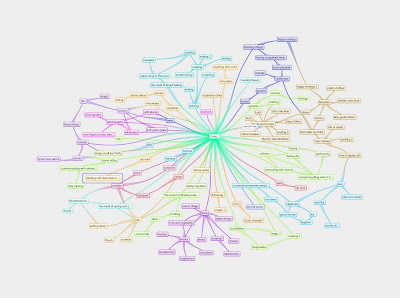
'Ears' and 'tails' were the items that amused me most :o) I have no IDEA what my muse is on about there - though I do have a propensity to greet close friends/family members by nibbling their ears while giving them a hello-hug, so maybe that explains ears??
And 'weather' I could have expanded on for hours... I adore weather. Food could have been expanded too, adding in more tasty goodness... But it was pretty cool to see what appeared :) This one's perhaps not as revealing as some of the other maps (I hate, I fear, I need), but it's fun nonetheless :)
Three weeks ago, I signed up for Holly Lisle's Think Sideways course. It's a six month online course, focusing on writing fiction with the aim of making a living from it - tips and tricks and strategies to get your career going and keep it going.
Three weeks into it, I'm loving it :)
As part of the course, we have weekly 'assignments', and a lot of people on the Think Sideways forums have been sharing their assignments for week two. I was kinda surprised, as well as interested and excited, in my own results, and I thought - where better to post them than here? :)
The assignment was to create a 'sweet spot map' - a random clustering of the first things that came to mind for each of six prompts: I love, I am drawn to, I get shivers from, I fear, I hate, I need. These are things that come (if you're really working 'randomly') from your subconscious, and are things that you can put into your writing no matter what genre you're writing in that will make it resonate with you; these are the things in your writing that are you.
I made my original map as recommended on six scrappy pieces of paper taped together - and I adore it, and am now carrying it everywhere with me, adding to it as things occur to me. However, for ease of viewing, I've used a nifty little program called Cayra, so that you won't have to decode my handwriting ;)
It's taking me a while to type the stuff in and detangle the resulting webby nets, so I'll pop the six maps up over the next few weeks. But first, for your viewing pleasure, an insight into what my subconscious - my dear little Muse *cough cough* - loves.

'Ears' and 'tails' were the items that amused me most :o) I have no IDEA what my muse is on about there - though I do have a propensity to greet close friends/family members by nibbling their ears while giving them a hello-hug, so maybe that explains ears??
And 'weather' I could have expanded on for hours... I adore weather. Food could have been expanded too, adding in more tasty goodness... But it was pretty cool to see what appeared :) This one's perhaps not as revealing as some of the other maps (I hate, I fear, I need), but it's fun nonetheless :)
Subscribe to:
Posts (Atom)
