Don't forget to enter the contest to win a copy of Michelle Davidson Argyle's awesome debut, Monarch.
For me, anyway, because people are all inspired by different things :)
1) Have other stuff that absolutely MUST be done in order for life to keep functioning. The more boring the better. Marking is perfect. (Writing as procrastination, #ftw!)
2) Read. Read lots. Read good books (so you can weep over how great you’ll never be). Read bad books (so you can gain confidence in knowing you can do better).
3) Collect random trivia (because you never know when the knowledge that a particular species of fungus turns ants into mind-controlled zombies might be useful).
4) Collect random images (because turning pretty I-wish-I’d-made-that images into words doesn’t count as plagiarism).
5) Play (because your muse, or imagination, or whatever term you like to use, is really just the grown-up term for your inner five-year-old).
Incidentally, my inner five-year-old is actually very determined that she’s an inner-six-but-NEARLY-SEVEN-year-old, and her name is Sarah, and she has brown pigtails and likes to wear white and pink, and lives in a bedroom with a white-painted cast-iron bed (the kind with rails down one side so it can pretend to be a chair, and gold caps on the four corner posts), a white bookcase and desk, pinky-red carpet and a large primary-coloured rug somewhere deep down in my right brain.
The sad thing is, I’m not even kidding, and I could draw you a picture of her, and then move on to draw pictures of my left brain (twenty-year-old university newspaper editor) and my hind brain (who bizarrely insists on being thirty-five and wearing an emerald-green satin formal gown) also.
I always knew I had issues. O.0 :P :D
Showing posts with label inspiration. Show all posts
Showing posts with label inspiration. Show all posts
20 October 2011

13 August 2010
To The Young
This post is dedicated to A. O'R. and P. D., both of whom are not allowed to read this blog for another two years.
'Never let anyone look down on you because you are young.' That's a good sentiment, that is, right there. And I'm privileged to know many, many talented young people who abide by it. These 'kids' are amazing examples - people with amazing talents who are out there doing something with them.
To those of you who write, I applaud you. There's no better time for learning how to write, for practicing writing, than now.
People will tell you you're too young; that you haven't had enough life experiences; that your writing will be over-written and melodramatic, shallow and uni-dimensional. People will tell you that your choice of genre is wrong, or even stupid; that you don't know enough, haven't read enough, haven't done enough or felt enough or lived long enough to know there's another side to the story.
These people are right, but they are also wrong. Because these are the people who see their own shortcomings and let them be an excuse. They are the ones who find something wrong and run away from it, who discover they aren't so good at adverbs and so quit using them, who fall over the first time they kick a soccer ball and never do it again.
These people are the quitters.
You, you young people who write - you are not quitters. Your writing probably will be over-written and melodramatic - but so is the writing of a lot of beginner writers, regardless of age. You may not have lived a broad range of life experiences - but neither have many adults. You might not have read widely in every genre on earth - but you can become a voracious consumer of your genre, and you can listen to the advice of other people who are more widely read. And yes, this still applies to adults and to those who have been writing forever. You might not have lived the other side of the story yet - but you know what? Neither have many adults who cling to their childhood hurts.
And above all else, you are not quitters. You will not let your limitations become barriers to success. You will find ways to overcome them. Where you do not know, you will ask. Where you have not experienced, you will find people who have. Where you have not encountered, you will research. You will imagine and believe, and contrary to public opinion, used correctly, these have far more power than any experience you can have.
Because mere experience doesn't change you. It's how you think about it, how you process it, that makes the difference. And you, who are deep thinkers, are capable without experience of more than any person is who has experienced without thought.
Young writers, I admire the heck out of you, and can only hope that one day I will be as innocently enthusiastic about life as you are, and that I will be able to approach each day, each sentence, each word, with the same passion and joy. For you are living, not merely being alive.
And to write, you must live.
For the rest of us, today's the day: find a young writer you know, and tell them how proud you are of them, of what they're trying to achieve. Writing is hard. Everyone deserves encouragment.
And to A. O'R. and P. D., never give up. Never quit. And I hope that in two years' time, when you are allowed to read this, you are still writing just as vivaciously as you are now.
Thank you - for sharing your writing with me, and for inspiring me. Thank you.
'Never let anyone look down on you because you are young.' That's a good sentiment, that is, right there. And I'm privileged to know many, many talented young people who abide by it. These 'kids' are amazing examples - people with amazing talents who are out there doing something with them.
To those of you who write, I applaud you. There's no better time for learning how to write, for practicing writing, than now.
People will tell you you're too young; that you haven't had enough life experiences; that your writing will be over-written and melodramatic, shallow and uni-dimensional. People will tell you that your choice of genre is wrong, or even stupid; that you don't know enough, haven't read enough, haven't done enough or felt enough or lived long enough to know there's another side to the story.
These people are right, but they are also wrong. Because these are the people who see their own shortcomings and let them be an excuse. They are the ones who find something wrong and run away from it, who discover they aren't so good at adverbs and so quit using them, who fall over the first time they kick a soccer ball and never do it again.
These people are the quitters.
You, you young people who write - you are not quitters. Your writing probably will be over-written and melodramatic - but so is the writing of a lot of beginner writers, regardless of age. You may not have lived a broad range of life experiences - but neither have many adults. You might not have read widely in every genre on earth - but you can become a voracious consumer of your genre, and you can listen to the advice of other people who are more widely read. And yes, this still applies to adults and to those who have been writing forever. You might not have lived the other side of the story yet - but you know what? Neither have many adults who cling to their childhood hurts.
And above all else, you are not quitters. You will not let your limitations become barriers to success. You will find ways to overcome them. Where you do not know, you will ask. Where you have not experienced, you will find people who have. Where you have not encountered, you will research. You will imagine and believe, and contrary to public opinion, used correctly, these have far more power than any experience you can have.
Because mere experience doesn't change you. It's how you think about it, how you process it, that makes the difference. And you, who are deep thinkers, are capable without experience of more than any person is who has experienced without thought.
Young writers, I admire the heck out of you, and can only hope that one day I will be as innocently enthusiastic about life as you are, and that I will be able to approach each day, each sentence, each word, with the same passion and joy. For you are living, not merely being alive.
And to write, you must live.
For the rest of us, today's the day: find a young writer you know, and tell them how proud you are of them, of what they're trying to achieve. Writing is hard. Everyone deserves encouragment.
And to A. O'R. and P. D., never give up. Never quit. And I hope that in two years' time, when you are allowed to read this, you are still writing just as vivaciously as you are now.
Thank you - for sharing your writing with me, and for inspiring me. Thank you.


16 July 2010
Hope
There’s nothing I can do, and that’s exactly the problem. If I could, I’d do everything. I’d carry it for you, I’d fall in your place, I’d hold your hand and die with you.
But there’s nothing I can do. sometimes, we have to stand on our own two feet.
You can’t stand up? It’s too heavy? You just want a break?
So do I. So do we all. See, life isn’t the moments were things are perfect, where things are pretty, where things are right. They’re the exception that proves the rule. Life is brutal. Life is hard. Life is clawing our way from one challenge to the next, battling to stay upright.
That’s life: the fight.
We fight against the dark and against the cold, we cling to what we have in the never-ending hope that things will someday, somehow, get better.
You’ve given up hope?
I’m sorry.
There is no life without hope.
Without hope, there’s just the struggle, the battle, the hard work and the effort and the exhaustion and the pain. Always, the pain.
Hope is like an anaesthetic; it helps to dull the pain. You should try it.
No, not like that. Not in a cheesy, superficial way with a too-bright smile that screams of the cracks underneath. Not even in a joyful way, that makes you dance and leap in spin – although that can be fun, in its time.
No, I mean like this. Quietly, patiently, somewhere deep in your soul. In here. Where there’s nothing else.
There’s nothing else because that’s where hope is supposed to sit. It’s a hope-shaped hole; hope’s all that will fill it up.
I know, I know you’ve tried before. But you have to keep on trying. Hope isn’t a one-time-only thing; it gets used up, like water, like life. You have to replenish, refresh. Here, take this, take my hand. I’ll give you some of mine.
No, it’s okay, I don’t need it. You have it. Yes, I’m sure. It’s okay.
I’ve felt it before, you see. I know what hope looks like. I’ll find it again, even if it takes a while. For now, I’d rather you have it. You need it more than I do. Here, in my hands – see the flames? Flickering orange and red and blue? That’s hope. It’s like a fire.
It’s like a fire, it’s like life; life is a fire. It burns.
But you can’t walk around empty. It’s cold. The fire will warm you, at least. If you’re burning you can’t die of cold. I know the heat is hard to handle. I know it makes you feel strange. Don’t cast it aside because of that, though. You’ll get used to it, in time. You will. And then you’ll wonder how you lived without it.
Cold. So cold.
Take the flames. Have them; they’re yours. I was only babysitting them for you. Really, they belong to you.
Take them. Breathe them. Be filled with hope – and life. Life is a struggle, life is a battle – but that’s life. To be human is to fight against it. Rage, rage against the coming of the night. That’s what it means to be human. To be alive.
Be human. Be alive.
Hope.
12 July 2010
Know More: Research
Just a quick post about something I read last week - a short phrase somewhere in a blog article, somewhere online. It was a question:
What are you researching?
The author noted that we should always be able to ask a fiction writer that question and have them answer. I thought that was interesting, since, in fact, I go through long periods of time where I'm not actually researching anything.
Quite possibly, I should be. And quite possibly, I do so without really thinking about it. And also quite possibly, I'm totally lazy and leave my researching for edits, where I know better what research I'll actually need and thus am not so likely to spend days researching methods of water purification in the 1400s when it turns out that what I actually needed was ways of sourcing water in the 1500s. So, maybe not lazy so much as a matter of knowing my perfectionist tendencies too well, and trying to avoid their clutches. O:)
But anyway. Researching. It occured to me, reading that question, that there are actually things I need to be actively researching, and there are random things that I could be reading (most of my TBR pile is non-fic) that would aid me on my continual quest to Know More, in order that I might write what I know. So, I'm sticking a new gadet in the sidebar, just to the left there about the Currently Reading list: a Currently Researching list, with links to random interesting stuff as I find it, or books that I'm reading for the research.
At present, I've been randomly researching early civilisations and their mythology, including Biblical mythology (and finding so many connections my brain is exploding with stories and glee). I'm also deliberately researching glass-making and the history of glass for my Shard series, since I'm planning to start editing Jesscapades in August. And I'm researching wolves - distribution, behaviour, population dynamics, interactions with humans - in preparation for another story that's been bubbling away in my mind.
Anyone else out there researching something cool? :)
What are you researching?
The author noted that we should always be able to ask a fiction writer that question and have them answer. I thought that was interesting, since, in fact, I go through long periods of time where I'm not actually researching anything.
Quite possibly, I should be. And quite possibly, I do so without really thinking about it. And also quite possibly, I'm totally lazy and leave my researching for edits, where I know better what research I'll actually need and thus am not so likely to spend days researching methods of water purification in the 1400s when it turns out that what I actually needed was ways of sourcing water in the 1500s. So, maybe not lazy so much as a matter of knowing my perfectionist tendencies too well, and trying to avoid their clutches. O:)
But anyway. Researching. It occured to me, reading that question, that there are actually things I need to be actively researching, and there are random things that I could be reading (most of my TBR pile is non-fic) that would aid me on my continual quest to Know More, in order that I might write what I know. So, I'm sticking a new gadet in the sidebar, just to the left there about the Currently Reading list: a Currently Researching list, with links to random interesting stuff as I find it, or books that I'm reading for the research.
At present, I've been randomly researching early civilisations and their mythology, including Biblical mythology (and finding so many connections my brain is exploding with stories and glee). I'm also deliberately researching glass-making and the history of glass for my Shard series, since I'm planning to start editing Jesscapades in August. And I'm researching wolves - distribution, behaviour, population dynamics, interactions with humans - in preparation for another story that's been bubbling away in my mind.
Anyone else out there researching something cool? :)
29 June 2010
Thank You To The Suits
As those that follow me on Twitter know, I'm in the Mire of Edits right now. Irritatingly, I've come to a point on all four of my current potential wips where I am stuck, for some reason or another. The only one for which I can see a clear way ahead is Hunter Hunted, the tiger novella, on which I am doing Holly Lisle's How To Revise Your Novel course.
Although I've made many attempts before, if I finish it, this will be the first time I've edited something longer than a short story; cheer-worthy, certainly, especially because I can see already how much better this story will be because of the edits - but also terrifying. Because the step after editing is submitting. Because actually editing something indicates that you plan to Do Something With It, whatever that something might be. It means you're serious.
Why is that scary? Because only serious people get rejected. If you're not serious, you can also fall back on that as the excuse for the rejection; Oh well, I didn't really try anyway. But of course, you can't succeed if you're not serious. You have to try if you want to win.
Thankfully, writing is very different in our day and age to what it once was; writing groups abound both online and in Real Life, making it easy to connect to other people that share your dreams, your fears, and your woes. Misery loves company, after all ;)
Nothing beats having a friend who's also a writer, who's at the same place you are, and who is determined to drag you on during your bad times, and who you drag one during their bad times. In an article I wrote for EdNoWriMo this year, I called these friends your Train-Proof Suits; the ones who protect you from the fear induced by the light at the end of the tunnel - because from this distance, trains and angels (or whatever the light is supposed to be) look identical.
This is part of what I sent to my Train-Proof Suit, Liana Brooks, yesterday:
It's just like all of a sudden I'm on the brink of being in a really new place with writing, one big step closer to professional - and I'm scared. I mean, this is what I want, it really is - but rejection is scary. Not doing means I can always sit here and think, 'Yes, I could have done that!' Doing means risking the chance that I'll die from rejection overload, and that I'll fail with a finality that can't be denied, and, and, and...
*sigh*
Nothing will solve this except me doing. So, I just need to do. One step at a time. And forget the scary eventual end of editing this novella, which is submitting for publication.
And this is her fantastic response:
It's going to be fine. We're going to get these stories sorted, polished, and sent off. The first one is the hardest, because you don't know what it will be like... Kinda like being pregnant I guess. Once you've started, you know it has to end. But the possibility of pain is scary and terrible and you wish you could stay pregnant forever. Until week 32 when you're ready to risk a preemie just to be done with the pregnancy. Going early is just as fatal with books as it is with children. And no one can stay pregnant forever.
*deep breath* *squeezes your hand* I'm right there with you. We'll do it. Together. It's going to be fine. Big smiles.
Big smiles indeed :) That is why you need your Suit, someone who's in it with you to the bitter end.
So to everyone out there who acts as a Suit for someone else: Thank you. You mean more than you'll ever know to the person you're Suiting for; they couldn't do it without you. Thank you.
Although I've made many attempts before, if I finish it, this will be the first time I've edited something longer than a short story; cheer-worthy, certainly, especially because I can see already how much better this story will be because of the edits - but also terrifying. Because the step after editing is submitting. Because actually editing something indicates that you plan to Do Something With It, whatever that something might be. It means you're serious.
Why is that scary? Because only serious people get rejected. If you're not serious, you can also fall back on that as the excuse for the rejection; Oh well, I didn't really try anyway. But of course, you can't succeed if you're not serious. You have to try if you want to win.
Thankfully, writing is very different in our day and age to what it once was; writing groups abound both online and in Real Life, making it easy to connect to other people that share your dreams, your fears, and your woes. Misery loves company, after all ;)
Nothing beats having a friend who's also a writer, who's at the same place you are, and who is determined to drag you on during your bad times, and who you drag one during their bad times. In an article I wrote for EdNoWriMo this year, I called these friends your Train-Proof Suits; the ones who protect you from the fear induced by the light at the end of the tunnel - because from this distance, trains and angels (or whatever the light is supposed to be) look identical.
This is part of what I sent to my Train-Proof Suit, Liana Brooks, yesterday:
It's just like all of a sudden I'm on the brink of being in a really new place with writing, one big step closer to professional - and I'm scared. I mean, this is what I want, it really is - but rejection is scary. Not doing means I can always sit here and think, 'Yes, I could have done that!' Doing means risking the chance that I'll die from rejection overload, and that I'll fail with a finality that can't be denied, and, and, and...
*sigh*
Nothing will solve this except me doing. So, I just need to do. One step at a time. And forget the scary eventual end of editing this novella, which is submitting for publication.
And this is her fantastic response:
It's going to be fine. We're going to get these stories sorted, polished, and sent off. The first one is the hardest, because you don't know what it will be like... Kinda like being pregnant I guess. Once you've started, you know it has to end. But the possibility of pain is scary and terrible and you wish you could stay pregnant forever. Until week 32 when you're ready to risk a preemie just to be done with the pregnancy. Going early is just as fatal with books as it is with children. And no one can stay pregnant forever.
*deep breath* *squeezes your hand* I'm right there with you. We'll do it. Together. It's going to be fine. Big smiles.
Big smiles indeed :) That is why you need your Suit, someone who's in it with you to the bitter end.
So to everyone out there who acts as a Suit for someone else: Thank you. You mean more than you'll ever know to the person you're Suiting for; they couldn't do it without you. Thank you.
07 December 2009
Writerly Advice #4: Be A Reader
In my previous 'Writerly Advice' posts I've mostly concentrated on advice that is often handed out without thought, and needs debunking. Today, by contrast, I'm going to focus on the positives: advice that is useful, positive, and warranted. Which is:
If you want to be a writer, you'd better be a reader.
Or any variation with similar intent.
I hope that most of you will find this piece of advice pretty self explanatory; in any business, to succeed, you have to know the business, and for a writer that means not only knowing how to market your book and find and agent and so on and so forth, it means knowing how to write, and knowing what's been written. We read to learn as well as to enjoy, to absorb the rhythm of Story.
Lots of people read; we'd hope so, or all us writers would be out of a job. But, to borrow a phrase from Holly Lisle, as writers, we read the opposite way around to most people.
Most people read fiction for fun, and if they want to learn something, they turn to non-fiction. As writers, we can, of course, read like 'normal' people; you'd hope we could find fiction fun, otherwise why the heck are we writing? And of course we learn things from non-fiction, too.
But here's the thing: we also read backwards. We read fiction with our writer brains engaged, observing the methods of the author. We examine the way the plot hangs together, the way the characters are developed, the particular phrases and rhythms that are employed, and how they're employed, and what effect that has on us. Maybe we don't do this all the time, but I have noticed one thing - writers are often a lot more specific about why they don't like a book than non-writers :D Whether you admit it or not, you're paying attention to this stuff when you read fiction.
In contrast, many writers read non-fiction for 'fun'. Sure, some of the stuff we read is pretty dry and can hardly be classed as exciting or thrilling stuff, but ultimately the reason why we read so much of it is to fill up our ideas tanks, to spark off things in our brains that will thrill us, to find those serendipitous phrases and ideas that connect with something in a current or future work and create flares of excitement and joy.
If you don't read non-fiction, and you plan to be serious about this whole writing thing, you need to ask yourself why not. Non-fiction is an insanely broad category, and if your protest is that you 'don't like' non-fiction, then I thumb my nose at you. All you mean is that you haven't read widely enough to find out what you're interested in. And if you're not reading non-fiction, where is the depth in your writing coming from? Where are your ideas coming from? Sure, from life, and also from the fiction you read - but why not add non-fic to the mix as well? Those of us that write spec fic particularly can find non-fiction to be a veritable mine-field of ideas and inspiration for world building, plot twists, concepts, characters...
My fav non-fic books are the DK series that include Earth, Ocean, Human and Animal (the four I have). The full-colour, glossy illustrations are the epitome of shiny :D I also love books on animal psychology, on human relationships (so useful for figuring out what makes characters really tick, and also aiding in writing realistic characters of the opposite genre), and on anything to do with food :D
So tell me: Do you read non-fic? How often? Do you find it a source of inspiration or do you just find it dull? Do you have favourite topics? Tell me, tell me! :D
If you want to be a writer, you'd better be a reader.
Or any variation with similar intent.
I hope that most of you will find this piece of advice pretty self explanatory; in any business, to succeed, you have to know the business, and for a writer that means not only knowing how to market your book and find and agent and so on and so forth, it means knowing how to write, and knowing what's been written. We read to learn as well as to enjoy, to absorb the rhythm of Story.
Lots of people read; we'd hope so, or all us writers would be out of a job. But, to borrow a phrase from Holly Lisle, as writers, we read the opposite way around to most people.
Most people read fiction for fun, and if they want to learn something, they turn to non-fiction. As writers, we can, of course, read like 'normal' people; you'd hope we could find fiction fun, otherwise why the heck are we writing? And of course we learn things from non-fiction, too.
But here's the thing: we also read backwards. We read fiction with our writer brains engaged, observing the methods of the author. We examine the way the plot hangs together, the way the characters are developed, the particular phrases and rhythms that are employed, and how they're employed, and what effect that has on us. Maybe we don't do this all the time, but I have noticed one thing - writers are often a lot more specific about why they don't like a book than non-writers :D Whether you admit it or not, you're paying attention to this stuff when you read fiction.
In contrast, many writers read non-fiction for 'fun'. Sure, some of the stuff we read is pretty dry and can hardly be classed as exciting or thrilling stuff, but ultimately the reason why we read so much of it is to fill up our ideas tanks, to spark off things in our brains that will thrill us, to find those serendipitous phrases and ideas that connect with something in a current or future work and create flares of excitement and joy.
If you don't read non-fiction, and you plan to be serious about this whole writing thing, you need to ask yourself why not. Non-fiction is an insanely broad category, and if your protest is that you 'don't like' non-fiction, then I thumb my nose at you. All you mean is that you haven't read widely enough to find out what you're interested in. And if you're not reading non-fiction, where is the depth in your writing coming from? Where are your ideas coming from? Sure, from life, and also from the fiction you read - but why not add non-fic to the mix as well? Those of us that write spec fic particularly can find non-fiction to be a veritable mine-field of ideas and inspiration for world building, plot twists, concepts, characters...
My fav non-fic books are the DK series that include Earth, Ocean, Human and Animal (the four I have). The full-colour, glossy illustrations are the epitome of shiny :D I also love books on animal psychology, on human relationships (so useful for figuring out what makes characters really tick, and also aiding in writing realistic characters of the opposite genre), and on anything to do with food :D
So tell me: Do you read non-fic? How often? Do you find it a source of inspiration or do you just find it dull? Do you have favourite topics? Tell me, tell me! :D
26 October 2009
Why Continue To Write?
So, you may or may not have noticed, but I’m slowly developing a trend on this blog for posting meatier, philosophical, more abstract posts on a Monday, more concrete posts on writing on a Wednesday, and fun stuff on a Friday.
I’m going to consolidate this a bit, because the next few Mondays I want to talk about something that’s come out of one of my university classes: what it means to write, and why I write. I touched on this subject once a while ago, but I never managed to reach a reason that seemed to me to be very satisfying.
Equipped with the thinking coming out of my uni class, I think that I now am.
So, let us begin: probably attacking the whole thing backwards, I want to look today at why I continue to write.
It is a fundamental fact that no one story can ever tell all there is to tell about the events it purports to describe. There will always be other aspects, other points of view, different places to begin, different places to end. When we write, we make decisions: What shall we put in? What shall we leave out? What is significant to what we’re trying to say or show? How do we know?
How readers read our text is a direct result of our decisions: if we neglect to mention that the main character’s hair is brown, some people may imagine it as blonde, or red – or blue. But does this matter? If yes, then we should probably amend the text to include that fact that the MC’s hair is brown.
What we choose to put in is important.
Equally important is what we choose to leave out.
Too often when we write, we leave things out without really thinking about them. We write from a certain point of view because that is the one that occurs to us; we choose the view of the world that will be presented because it ‘feels’ right. We write the story because that’s how the story works, without stopping to consider what the long-lasting impacts in the story world might be; how other characters might feel about the story; whether what we’re saying really does justice to the issue at the heart of it, or whether we’re over-simplifying.
Issues are complex. Life is complex. And I love writing because it allows me to ponder this. Okay, so the hero won the day and evil is vanquished – but what Mr Evil Dude’s family? He had parents, somewhere, presumably. How do they feel about this so-called hero, who just murdered their only son?
Okay, so Mr X murdered a guy, which almost by definition makes him a Bad Person. But what if he hadn’t? What if the guy had lived? What if it would have made the world a worse place, would have turned it inside out and made it chaos?
This goes even for stories which purport to subvert genres norms: Okay, so you’re writing about the bad guys. Why? What are you leaving out on the hero’s side of things?
What ‘s left out matters as much as what’s left in.
So why do I continue to write? Because no one story can ever say it all.
Why do you continue to write?
I’m going to consolidate this a bit, because the next few Mondays I want to talk about something that’s come out of one of my university classes: what it means to write, and why I write. I touched on this subject once a while ago, but I never managed to reach a reason that seemed to me to be very satisfying.
Equipped with the thinking coming out of my uni class, I think that I now am.
So, let us begin: probably attacking the whole thing backwards, I want to look today at why I continue to write.
It is a fundamental fact that no one story can ever tell all there is to tell about the events it purports to describe. There will always be other aspects, other points of view, different places to begin, different places to end. When we write, we make decisions: What shall we put in? What shall we leave out? What is significant to what we’re trying to say or show? How do we know?
How readers read our text is a direct result of our decisions: if we neglect to mention that the main character’s hair is brown, some people may imagine it as blonde, or red – or blue. But does this matter? If yes, then we should probably amend the text to include that fact that the MC’s hair is brown.
What we choose to put in is important.
Equally important is what we choose to leave out.
Too often when we write, we leave things out without really thinking about them. We write from a certain point of view because that is the one that occurs to us; we choose the view of the world that will be presented because it ‘feels’ right. We write the story because that’s how the story works, without stopping to consider what the long-lasting impacts in the story world might be; how other characters might feel about the story; whether what we’re saying really does justice to the issue at the heart of it, or whether we’re over-simplifying.
Issues are complex. Life is complex. And I love writing because it allows me to ponder this. Okay, so the hero won the day and evil is vanquished – but what Mr Evil Dude’s family? He had parents, somewhere, presumably. How do they feel about this so-called hero, who just murdered their only son?
Okay, so Mr X murdered a guy, which almost by definition makes him a Bad Person. But what if he hadn’t? What if the guy had lived? What if it would have made the world a worse place, would have turned it inside out and made it chaos?
This goes even for stories which purport to subvert genres norms: Okay, so you’re writing about the bad guys. Why? What are you leaving out on the hero’s side of things?
What ‘s left out matters as much as what’s left in.
So why do I continue to write? Because no one story can ever say it all.
Why do you continue to write?
09 April 2009
What Makes A Good Writer?
So, a conversation I had some time ago with a friend of mine went something like this:
Friend: she... she's a good writer, but she isn't ready to be a good writer, if that makes sense
Inky: she has no sense of self-worth - yes, that makes sense
Friend: no kidding
Inky: you need a bit of inner strength to be a truly good writer, I think
Which brings me to today's topic: What makes a good writer? What are the qualities that good writers possess?Friend: she... she's a good writer, but she isn't ready to be a good writer, if that makes sense
Inky: she has no sense of self-worth - yes, that makes sense
Friend: no kidding
Inky: you need a bit of inner strength to be a truly good writer, I think
Obviously, the thing at the head of our list will be 'can write well', followed closely by 'can edit well', followed again by 'writes regularly' (and I'm not talking regularly as in the way I horseride, which is extremely regularly, but not very frequently - once a year, to be precise :D).
But other than the ability to write, and to do it day after day, what does a writer need?
Persistence. Flexibility. The ability to adapt and change. (See here. There's also a nifty quiz you can take here). The ability to listen to the advice of others, and take constructive criticism.
All these are pretty logical, and are quite obvious when you think about it. Anyone who's been dabbling in the writing industry for any genuine length of time should be able to find a whole bunch of sources that agree with these qualities.
But.
But what? But a lot of people have these qualities, and it still never happens for them. A lot of people are good writers, midlist writers; but some people are great writers.
Sadly, I'm not (yet) one of those, so what I say here is pure speculation. One day I hope to hold empirical evidence in my hand as to the true of my suspicions, but for now, suspicions:
I think that to be a great writer, you need to know deep down that no matter what people say, you are still of worth, and what you say and think has value. You need to know you have a story to tell, and you need to be one hundred percent committed to getting it out there. You need to value it, and you need to value yourself.
And above that, because you value yourself, because you value your story, and because you're committed to making both the best you can be, you need to be able to dig deep within yourself and rip out your heart, and plaster it to the page. A bit dramatic, maybe, but it equates to this: You must be able to write honestly.
And that, I think, is the difference between books which are merely good, and those which have become classics (in whatever genre). The writers of the classics are honest; they're not fooling anyone, and least of all themselves. They respect themselves enough to dig deeply, past the pain, and find the truth - and it lights up their work and makes it shine throughout the centuries.
Of course, I could be wrong. This is just my random thought for the day. So tell me, what do you think??
23 March 2009
Random: Losing Yourself In Writing
Have you ever had the experience of losing yourself in your writing? Of sitting down to start and getting up an hour later, shocked at how much time has passed because the words just kept on coming?
Turns out, if you have, it's actually good for your internal happiness, and thereby your health. And if you haven't, investigate - there are strategies you can learn that can help you enjoy what you do - in writing, in life - more :) It's all about finding out what your 'happiness strengths' are, and finding ways to exercise them more in what you do every day.
I love the feeling of losing myself in my writing, but it doesn't happen often. My top strength, according to the survey on Authentic Happiness (the website of Dr Seligman, who presents the video below), is open-mindedness. It took a bit of creative thinking to come up with a way to include that in my writing (heh, lucky creativity is near the top of the list too! :D), but I've decided that at least one way I can do it is through listening to my characters more. By allowing them to have their own thoughts and feelings and opinions, and by allowing those to be different from my own, I'm exercising my ability to be open-minded, which will make me happier because it's something I enjoy and am apparently good at - and hopefully, it'll make me happy because it gets more writing done! :D
And, quite coincedentally, it will hopefully address a problem I've been having with the characters in my novels: they end up all sounding the same!
So go, watch the video, and tell me - what's your happiness strength? :)
Turns out, if you have, it's actually good for your internal happiness, and thereby your health. And if you haven't, investigate - there are strategies you can learn that can help you enjoy what you do - in writing, in life - more :) It's all about finding out what your 'happiness strengths' are, and finding ways to exercise them more in what you do every day.
I love the feeling of losing myself in my writing, but it doesn't happen often. My top strength, according to the survey on Authentic Happiness (the website of Dr Seligman, who presents the video below), is open-mindedness. It took a bit of creative thinking to come up with a way to include that in my writing (heh, lucky creativity is near the top of the list too! :D), but I've decided that at least one way I can do it is through listening to my characters more. By allowing them to have their own thoughts and feelings and opinions, and by allowing those to be different from my own, I'm exercising my ability to be open-minded, which will make me happier because it's something I enjoy and am apparently good at - and hopefully, it'll make me happy because it gets more writing done! :D
And, quite coincedentally, it will hopefully address a problem I've been having with the characters in my novels: they end up all sounding the same!
So go, watch the video, and tell me - what's your happiness strength? :)
18 December 2008
The Origins of InkfeverPLUS
So, because even after I promised I'd get back on track with posting yesterday I still missed yesterday's post, today you get a double episode :o) There's this post, and a book review below :)
By now, a lot of you know that I have a sister-site to this one: InkfeverPLUS, a website devoted to my novels where you can find character profiles and pictures, novel blurbs, maps, photos, drawings, and a whole assortment of novel-related Stuff which I am slowly in the process of adding to the site.
Thanks hugely to all those of you who have already joined up. For those of you that want to, but haven't, leave a comment with your email address, or email me and I'll send you an invite. Yes, I'm keeping it invite-only for now to ensure that I'm on the 'better safe than sorry' side of the copyright fence ;)
However, what a lot of you won't know - and apparently, what some of you would like to know - is where I got the idea for the site :)
In a way, this connects with How I Really Got Serious About Writing. In February of 2007, I can't recall how, but I found both Holly Lisle's website, and Critique Circle. Both of these sites have quite literally changed my world: Holly for the fantastic articles, clinics, and courses that you can find on her site, and Critique Circle both for the skills I have learned from critiquing, and the life-long friends I have made *waves to them all* :)
In terms of the InkfeverPLUS site, though, it was Holly Lisle's site that was most influential. She has so much information on there especially for writers, and she talks a lot about the concept of 'paying forward': you'll never be able to adequately thank those who help you on your way in your writing career - and sometimes you won't be able to thank them at all - but you can make a difference and show your gratitude by passing it on, by helping others who come after you.
This is a principle that really resonated with me, and it's something I definitely plan to do. Whether or not I'm successful - whether what I have to share is actually helpful or not :D - is another matter O:)
So. That's part one of why I designed the InkfeverPLUS site: at the moment it only houses novel-related things, geared more towards readers than writers, but one day, everything will merge into a lovely big connected website for readers and writers alike :) Hoorah!
Part two relates to the design of the site, for the inspiration for which I must thank the lovely Michelle, better known to me as Glam :) If you click her name, it will take you to her blog - and halfway down the sidebar you'll see a link to her other blog, one for her novel Breakaway. Now, this blog is actually in the process of coming down, so don't go flooding her with requests to join it :D but it's where I got the inspiration for the site design from. Glam set up the blog with the novel chapters all listed in the sidebar, a stable front page post, links to extras for the novel, and all sorts of goodies.
I fell in love.
Between the two of us, we nutted out some tricky features of site design (if you're interested in knowing how to do it, I've actually typed it all up in a word document with screen shots and everything O:) *is clearly not a perfectionist*) and voila! I now have a shiny, lovely InkfeverPLUS.
There's not as much on there as there could be quite yet - none of the maps have made it up, for example - but I plan to devote a good chunk of time in January and February to adding things and bringing it all as uptodate as I can. If you'd like an invite, just let me know ;)
So that, dear lovelies, is how I came to develop the InkfeverPLUS site. I hope that sates your curiousity :)
By now, a lot of you know that I have a sister-site to this one: InkfeverPLUS, a website devoted to my novels where you can find character profiles and pictures, novel blurbs, maps, photos, drawings, and a whole assortment of novel-related Stuff which I am slowly in the process of adding to the site.
Thanks hugely to all those of you who have already joined up. For those of you that want to, but haven't, leave a comment with your email address, or email me and I'll send you an invite. Yes, I'm keeping it invite-only for now to ensure that I'm on the 'better safe than sorry' side of the copyright fence ;)
However, what a lot of you won't know - and apparently, what some of you would like to know - is where I got the idea for the site :)
In a way, this connects with How I Really Got Serious About Writing. In February of 2007, I can't recall how, but I found both Holly Lisle's website, and Critique Circle. Both of these sites have quite literally changed my world: Holly for the fantastic articles, clinics, and courses that you can find on her site, and Critique Circle both for the skills I have learned from critiquing, and the life-long friends I have made *waves to them all* :)
In terms of the InkfeverPLUS site, though, it was Holly Lisle's site that was most influential. She has so much information on there especially for writers, and she talks a lot about the concept of 'paying forward': you'll never be able to adequately thank those who help you on your way in your writing career - and sometimes you won't be able to thank them at all - but you can make a difference and show your gratitude by passing it on, by helping others who come after you.
This is a principle that really resonated with me, and it's something I definitely plan to do. Whether or not I'm successful - whether what I have to share is actually helpful or not :D - is another matter O:)
So. That's part one of why I designed the InkfeverPLUS site: at the moment it only houses novel-related things, geared more towards readers than writers, but one day, everything will merge into a lovely big connected website for readers and writers alike :) Hoorah!
Part two relates to the design of the site, for the inspiration for which I must thank the lovely Michelle, better known to me as Glam :) If you click her name, it will take you to her blog - and halfway down the sidebar you'll see a link to her other blog, one for her novel Breakaway. Now, this blog is actually in the process of coming down, so don't go flooding her with requests to join it :D but it's where I got the inspiration for the site design from. Glam set up the blog with the novel chapters all listed in the sidebar, a stable front page post, links to extras for the novel, and all sorts of goodies.
I fell in love.
Between the two of us, we nutted out some tricky features of site design (if you're interested in knowing how to do it, I've actually typed it all up in a word document with screen shots and everything O:) *is clearly not a perfectionist*) and voila! I now have a shiny, lovely InkfeverPLUS.
There's not as much on there as there could be quite yet - none of the maps have made it up, for example - but I plan to devote a good chunk of time in January and February to adding things and bringing it all as uptodate as I can. If you'd like an invite, just let me know ;)
So that, dear lovelies, is how I came to develop the InkfeverPLUS site. I hope that sates your curiousity :)
05 December 2008
Link-a-bet Soup
*sigh* I was supposed to post on The Sentence today, however my brain has gone awol, my back is broken, and 'tis subsequently impossible to think. I'm very sorry. The Sentence post will come next week, I promise :)
Besides, it's traditional to post something slackerly on a Friday O:)
EDITED TO ADD: I totally did not realise that in order to access the Inkfever Download Area, you were required to have a pbwiki account. This was a mistake on my behalf, which has now been rectified: anyone is now able to view this site, with or without a pbwiki account.
Re the title of this post: Yes, no more Link Salads. I completely thieved the concept from a well-known agent, and it's high time I got original and came up with my own name ;):D
A whole bunch of random, interesting sites this week. First off, have you ever stressed about where your gold comes from? If you're like most people, probably not - people are generally more worried about where it goes O:) But, for the eco-friendly among us, I present GreenKarat.
And on the topic of the environment, you simply must watch this. It's half an hour well invested ;)
Which leads into this article - when science fiction morphed into politics.
Speaking of politics, censorship is something that's been discussed a bit lately. Neil Gaiman has his say.
But really, in the midst of an economic crisis, can we talk about writing anything as a career? Perhaps we're all condemned to be starving writers...
Though at least, if we write, we have a voice - and if you need help with that, this is a great article on what voice is. And if we have voice, it's because we have something to say - that's why we're writers, after all, right? So, who are we writing for?
Of course, the whole crisis thing could just make you want to go out and scream, or do stupid things like (gross warning) tattoo your eyeballs....
Or you could just get eaten by a velociraptor. That works too.
I could survive for 54 seconds chained to a bunk bed with a velociraptor
Besides, it's traditional to post something slackerly on a Friday O:)
EDITED TO ADD: I totally did not realise that in order to access the Inkfever Download Area, you were required to have a pbwiki account. This was a mistake on my behalf, which has now been rectified: anyone is now able to view this site, with or without a pbwiki account.
Re the title of this post: Yes, no more Link Salads. I completely thieved the concept from a well-known agent, and it's high time I got original and came up with my own name ;):D
A whole bunch of random, interesting sites this week. First off, have you ever stressed about where your gold comes from? If you're like most people, probably not - people are generally more worried about where it goes O:) But, for the eco-friendly among us, I present GreenKarat.
And on the topic of the environment, you simply must watch this. It's half an hour well invested ;)
Which leads into this article - when science fiction morphed into politics.
Speaking of politics, censorship is something that's been discussed a bit lately. Neil Gaiman has his say.
But really, in the midst of an economic crisis, can we talk about writing anything as a career? Perhaps we're all condemned to be starving writers...
Though at least, if we write, we have a voice - and if you need help with that, this is a great article on what voice is. And if we have voice, it's because we have something to say - that's why we're writers, after all, right? So, who are we writing for?
Of course, the whole crisis thing could just make you want to go out and scream, or do stupid things like (gross warning) tattoo your eyeballs....
Or you could just get eaten by a velociraptor. That works too.
I could survive for 54 seconds chained to a bunk bed with a velociraptor
Created by Bunk Beds.net
14 October 2008
Book Review: Sex, Lies and Handwriting
And that's two!
Quick Stats
Genre - Non fiction
Length - About 300 pages of largish print
Author - Michelle Dresbold
Overview
"Handwriting expert Michelle Dresbold -- the only civilian to be invited to the United States Secret Service's Advanced Document Examination training program -- draws on her extensive experience helping law enforcement agencies around the country on cases involving kidnapping, arson, forgery, murder, embezzlement, and stalking to take us inside the mysterious world of crossed t's and dotted i's. ... Looks can be deceiving, but handwriting never lies."
First Impressions
Excellent. The author gives good, clear examples and applications to real-life cases that she's worked on, which is great. I found myself going, "Just one more section, I'll only read one more"... She introduces you to the basics quick enough that you can get a handle on what's going on, and see what she's talking about.
High Points
The tone of the book, which is incredibly easy to read and is entertaining as it informs. The concrete examples, even if they are occasionally contradictory (see low points). The real-life applications - this book is choc full of actual criminal investigations and analyses of writing that broke cases. Much coolness.
Low Points
The fact that according to how I interpret what she's saying, my handwriting says I'm a con-artist* who can't keep a secret and has a quick temper. *less than impressed* Yes, I have scrawly handwriting. No, I don't think it's because I have a deep-seated desire to confuse people with what I'm saying, or to deliberately make it illegible. I think it's because I'm too lazy to write neatly, and write very fast in order to get all my thoughts down as quick as possible. I hate handwriting. That's what keyboards are for. (On the plus side, my handwriting also shows I'm an upbeat, happy kind of person.)
Besides, doctors have scrawly handwriting, and they're not all con-artists, are they? (hehe, maybe don't answer that one O:))
The other thing that annoyed me a little about this book stems from the fact that I am not a black and/or white person. Shades of grey, people, shades of grey! Circumstances matter! Just because something means such-and-such in isolation, doesn't mean it means that all the time. Of course, the black-and-white-ness of the book is, I think, caused by the fact that she's trying to pack years' worth of learning into a single, easy-to-read beginner's book. I'm willing to give the benefit of the doubt that handwriting analysis isn't actually so clearcut :)
Rating
This was my read-during-the-quiet-times-at-work book. Sections are small enough that you can read them in sometimes under a minute, so it's perfect for having around to read in small snatches and bites :) And despite the title, it's a respectible enough book that you don't get odd looks when someone asks you what you're reading :D
Non-fic books will get an additional rating: Application to Writing (since that is, after all, the point of this blog!). Sex, Lies and Handwriting was fun to read, but unless you happen to be writing crime scene investigation novels where the MC could utilise handwriting analysis, it's probably not the most useful non-fic book. It's not really something you can just drop into a novel unless you've set it up.
(The miller's daughter looked down at the note the farmer's son had passed her. Oh no, she thought. He slashes his i's. And look at those t's! Not to mention the anatagonist p's... And my, oh my, is that a weapon stroke I see? Methinks I shall stay far away from this 'gentleman'...)
Indeed.
* Pondering on this later, it occurred to me that perhaps I am a conartist. I am a writer, after all, O:) the whole business of which is to dupe people into believing our lies (stories)...
Quick Stats
Genre - Non fiction
Length - About 300 pages of largish print
Author - Michelle Dresbold
Overview
"Handwriting expert Michelle Dresbold -- the only civilian to be invited to the United States Secret Service's Advanced Document Examination training program -- draws on her extensive experience helping law enforcement agencies around the country on cases involving kidnapping, arson, forgery, murder, embezzlement, and stalking to take us inside the mysterious world of crossed t's and dotted i's. ... Looks can be deceiving, but handwriting never lies."
First Impressions
Excellent. The author gives good, clear examples and applications to real-life cases that she's worked on, which is great. I found myself going, "Just one more section, I'll only read one more"... She introduces you to the basics quick enough that you can get a handle on what's going on, and see what she's talking about.
High Points
The tone of the book, which is incredibly easy to read and is entertaining as it informs. The concrete examples, even if they are occasionally contradictory (see low points). The real-life applications - this book is choc full of actual criminal investigations and analyses of writing that broke cases. Much coolness.
Low Points
The fact that according to how I interpret what she's saying, my handwriting says I'm a con-artist* who can't keep a secret and has a quick temper. *less than impressed* Yes, I have scrawly handwriting. No, I don't think it's because I have a deep-seated desire to confuse people with what I'm saying, or to deliberately make it illegible. I think it's because I'm too lazy to write neatly, and write very fast in order to get all my thoughts down as quick as possible. I hate handwriting. That's what keyboards are for. (On the plus side, my handwriting also shows I'm an upbeat, happy kind of person.)
Besides, doctors have scrawly handwriting, and they're not all con-artists, are they? (hehe, maybe don't answer that one O:))
The other thing that annoyed me a little about this book stems from the fact that I am not a black and/or white person. Shades of grey, people, shades of grey! Circumstances matter! Just because something means such-and-such in isolation, doesn't mean it means that all the time. Of course, the black-and-white-ness of the book is, I think, caused by the fact that she's trying to pack years' worth of learning into a single, easy-to-read beginner's book. I'm willing to give the benefit of the doubt that handwriting analysis isn't actually so clearcut :)
Rating
This was my read-during-the-quiet-times-at-work book. Sections are small enough that you can read them in sometimes under a minute, so it's perfect for having around to read in small snatches and bites :) And despite the title, it's a respectible enough book that you don't get odd looks when someone asks you what you're reading :D
Non-fic books will get an additional rating: Application to Writing (since that is, after all, the point of this blog!). Sex, Lies and Handwriting was fun to read, but unless you happen to be writing crime scene investigation novels where the MC could utilise handwriting analysis, it's probably not the most useful non-fic book. It's not really something you can just drop into a novel unless you've set it up.
(The miller's daughter looked down at the note the farmer's son had passed her. Oh no, she thought. He slashes his i's. And look at those t's! Not to mention the anatagonist p's... And my, oh my, is that a weapon stroke I see? Methinks I shall stay far away from this 'gentleman'...)
Indeed.
* Pondering on this later, it occurred to me that perhaps I am a conartist. I am a writer, after all, O:) the whole business of which is to dupe people into believing our lies (stories)...
10 October 2008
Always Do Something - Another Reason To Nano
 If you're looking for one more reason to do Nano, here it is. In their book Art and Fear, Bayles and Orland discuss the principle of quantity over quality. The relevant bit is quoted on the webpage, and goes like this:
"The ceramics teacher announced on opening day that he was dividing the class into two groups. All those on the left side of the studio, he said, would be graded solely on the quantity of work they produced, all those on the right solely on its quality.
His procedure was simple: on the final day of class he would bring in his bathroom scales and weigh the work of the "quantity" group: fifty pound of pots rated an "A", forty pounds a "B", and so on. Those being graded on "quality", however, needed to produce only one pot - albeit a perfect one - to get an "A".
Well, came grading time and a curious fact emerged: the works of highest quality were all produced by the group being graded for quantity. It seems that while the "quantity" group was busily churning out piles of work - and learning from their mistakes - the "quality" group had sat theorizing about perfection, and in the end had little more to show for their efforts than grandiose theories and a pile of dead clay. "
Right now, I'm struggling through a first draft. I HATE first drafts with a passion that sometimes makes me wonder why I'm doing this whole writing thing. First drafts SUCK because they are never, ever, EVER perfect - and I'm a perfectionist.
When we're stuck in the quagmire of an imperfect first draft - or caught in the death grips of editing, for those of you that hate that bit of the process - it's so easy to lose sight of what we love about writing. It's so easy to fall back into the default position - everything I write is terrible, I'm no good at this, I think I'll quit.
Don't. Quit.
Every word you write, every sentence you think, every scene you bash your head against the desk over - everything you read over later and wonder what you were on at the time... It's Something. It's Practice. You're Learning.
Quantity. To improve, you must practice. And practice means volume.
Go. Write. Do something.
24 September 2008
Progress and the Weight of Decisions
In today's post, I was going to talk about progress, and how you know you've made it. It's something a friend of mine has been struggling with recently, and it's been making me think - about achievements, about goals, about motion and momentum and today, about decisions. The importance of decisions hit me in a big way today. And, in its own way, it relates to what I intended to say. Intended consequences, and unintended consequences. Once you've read this article, you'll know what I mean by that.
So today, you're getting what could really be two articles, smooshed into one. I hope it makes sense to you; it does to me.
Week ten of Think Sideways: the Law of Unintended Consequences.
I'm not going to go into it today, because I'll do that when I recap month three of the course (month two recap coming up later this week). But this lesson hit me in a big way, and I think is relevant to the whole notion of progress.
Progress.
For me, it's a very loaded word. On my bad days, it's one of two words that float around my head, leering at me, taunting, laughing, reminding me of my failures. (The other word, in case you're curious, is Productive). But nonetheless, it's something that's important, not only to writing, but to any career - and even to us as people outside of our careers.
Another way of phrasing it is growth. To get by in this life, we have to grow.
But how can we tell whether we're growing or not? What are the markers by which we can measure ourselves, by which we can compare and say, 'Yes, I have Grown'?
The first important thing to recognise is that usually, growth is a gradual process. Just like children, you don't notice their growth every single day, even though they are growing. You turn around one day after several months, and go, "My GOODness! I swear you didn't used to come up to my eyebrows!" Growth is often slow, and requires patience. Some estimates place the writer's 'aprenticeship' stage at ten years; that's a lot of patience.
But short of waiting out those ten years and realising how much you've done, how do you recognise growth, progress, when you see it?
Goals. And not just having goals, and reaching them. I'm talking here about the kind of goals you set, and how that changes over time. I keep a record of all my goals in a spreadsheet in my writing folder, and because of that I can have a real sense of progress even over the last year, just by examining the way in which my goals have changed. Sixteen months ago, I had never written more than 3,000 words together on any one project. Ten months ago, I had never completed a novel. Six months ago, I had never written a short story which I was proud of. Five months ago, I had never submitted anything for publication. By tracking the type of goals I've made, I can track the change in my focus, and that tells me a lot about where I am in my writing career.
Back to Think Sideways. This week is talking about the way in which you plan for surprises in your writing - because things that surprise you will most likely surprise your readers. To do this, the Law of Unintended Consequences comes into play: an action occurs, and most often we deal with the intended consequences. Bob gets the new promotion he's been after, Bob gets more money and sense of prestige.
But to make your writing surprising, you need to also look for the unintended consequences: Bob's new prestigious position requires more hours at the office; Bob's home life suffers; Bob's wife takes the children and leaves him. Or, if you prefer, Bob's promotion means he is now entitled to a secretary; Bob doesn't get so stressed out at work and can take time off knowing things will still be done; Bob takes his family on that holiday they've been planning for years; Bob's children grow up with fond memories of their times together.
What hit me most about this lesson was the moment where we were asked to consider our own lives. What moments in time do we have in our own lives where a decision was made, and unintended consequences ensued, and our lives, for better or worse, were changed?
Stop. Right now. Close your eyes, and think of a time when you made a decision. What did you intend to happen? What actually happened? How has this changed your life?
Here are some of my examples:
At the end of 2005, I realised law was probably not the career for me. I decided that if certain things happened, I would drop law, finish my arts degree, and go train to be a teacher. The intended consequences of this were that I would be able to study English in my arts degree; I would have a career as a teacher which is more family- and writing-friendly than law. The unintended consequences?
I thought long and hard about this one. And you know what I came up with? Nothing less than the entire health and stability of my marriage. And that affects me not only now, but well into the future, and will impact my children, and thus their children... How did this come about? You see, because I had already done some of my arts degree concurrently with law, I had only the equivalent of three semesters to go. Instead of doing that, and having to work for a semester before going to teaching, I decided to spread my subjects out, and do a three-quarters load for four semesters.
Last year, the final year of my arts degree, and my husband's final year of his architecture masters, was nothing short of a personal, private hell. Husband's uni was messy and complicated and draining and unfair and horrible in so many ways (some of his classmates were put onto anti-depressants due to the stress), and I was called upon in ways I could NEVER have anticipated when we were married to support someone who had always been MY rock, MY stability.
By the grace of God we got through, and I am here to tell you right now that if I had been doing not only a full load, but law subjects as well, we would not have survived.
One tiny moment, where seeing the right friend in the right place at the right time prompted me to do what I'd previously been too scared to do and switch courses, and our lives were changed. This time, thank God, for the better.
So. Progress. How does this relate to the idea of progress? Decisions. Goals. Simply by dint of the fact that every single thing you do, every single choice you make, can impact your life in ways that you will never, ever appreciate until they happen. You might feel stuck in a rut, you may feel like your talent has plateaued, like you've been banging your head against a brick wall for so long now and nothing is going to change...
But change is the only constant in life. Things will change. And they will change based on the consequences, intended and unintended, of what you are doing right now.
Go. Write. Trust that, like children growing, any movement is motion even if it's too small to see. Trust the consequences of your actions, and have faith in their ability to spiral.
Oak trees from acorns - massive success or failure based on one tiny moment in time.
You can be all that you ever hoped - or you can not.
The choice is yours.
Decide.
So today, you're getting what could really be two articles, smooshed into one. I hope it makes sense to you; it does to me.
Week ten of Think Sideways: the Law of Unintended Consequences.
I'm not going to go into it today, because I'll do that when I recap month three of the course (month two recap coming up later this week). But this lesson hit me in a big way, and I think is relevant to the whole notion of progress.
Progress.
For me, it's a very loaded word. On my bad days, it's one of two words that float around my head, leering at me, taunting, laughing, reminding me of my failures. (The other word, in case you're curious, is Productive). But nonetheless, it's something that's important, not only to writing, but to any career - and even to us as people outside of our careers.
Another way of phrasing it is growth. To get by in this life, we have to grow.
But how can we tell whether we're growing or not? What are the markers by which we can measure ourselves, by which we can compare and say, 'Yes, I have Grown'?
The first important thing to recognise is that usually, growth is a gradual process. Just like children, you don't notice their growth every single day, even though they are growing. You turn around one day after several months, and go, "My GOODness! I swear you didn't used to come up to my eyebrows!" Growth is often slow, and requires patience. Some estimates place the writer's 'aprenticeship' stage at ten years; that's a lot of patience.
But short of waiting out those ten years and realising how much you've done, how do you recognise growth, progress, when you see it?
Goals. And not just having goals, and reaching them. I'm talking here about the kind of goals you set, and how that changes over time. I keep a record of all my goals in a spreadsheet in my writing folder, and because of that I can have a real sense of progress even over the last year, just by examining the way in which my goals have changed. Sixteen months ago, I had never written more than 3,000 words together on any one project. Ten months ago, I had never completed a novel. Six months ago, I had never written a short story which I was proud of. Five months ago, I had never submitted anything for publication. By tracking the type of goals I've made, I can track the change in my focus, and that tells me a lot about where I am in my writing career.
Back to Think Sideways. This week is talking about the way in which you plan for surprises in your writing - because things that surprise you will most likely surprise your readers. To do this, the Law of Unintended Consequences comes into play: an action occurs, and most often we deal with the intended consequences. Bob gets the new promotion he's been after, Bob gets more money and sense of prestige.
But to make your writing surprising, you need to also look for the unintended consequences: Bob's new prestigious position requires more hours at the office; Bob's home life suffers; Bob's wife takes the children and leaves him. Or, if you prefer, Bob's promotion means he is now entitled to a secretary; Bob doesn't get so stressed out at work and can take time off knowing things will still be done; Bob takes his family on that holiday they've been planning for years; Bob's children grow up with fond memories of their times together.
What hit me most about this lesson was the moment where we were asked to consider our own lives. What moments in time do we have in our own lives where a decision was made, and unintended consequences ensued, and our lives, for better or worse, were changed?
Stop. Right now. Close your eyes, and think of a time when you made a decision. What did you intend to happen? What actually happened? How has this changed your life?
Here are some of my examples:
At the end of 2005, I realised law was probably not the career for me. I decided that if certain things happened, I would drop law, finish my arts degree, and go train to be a teacher. The intended consequences of this were that I would be able to study English in my arts degree; I would have a career as a teacher which is more family- and writing-friendly than law. The unintended consequences?
I thought long and hard about this one. And you know what I came up with? Nothing less than the entire health and stability of my marriage. And that affects me not only now, but well into the future, and will impact my children, and thus their children... How did this come about? You see, because I had already done some of my arts degree concurrently with law, I had only the equivalent of three semesters to go. Instead of doing that, and having to work for a semester before going to teaching, I decided to spread my subjects out, and do a three-quarters load for four semesters.
Last year, the final year of my arts degree, and my husband's final year of his architecture masters, was nothing short of a personal, private hell. Husband's uni was messy and complicated and draining and unfair and horrible in so many ways (some of his classmates were put onto anti-depressants due to the stress), and I was called upon in ways I could NEVER have anticipated when we were married to support someone who had always been MY rock, MY stability.
By the grace of God we got through, and I am here to tell you right now that if I had been doing not only a full load, but law subjects as well, we would not have survived.
One tiny moment, where seeing the right friend in the right place at the right time prompted me to do what I'd previously been too scared to do and switch courses, and our lives were changed. This time, thank God, for the better.
So. Progress. How does this relate to the idea of progress? Decisions. Goals. Simply by dint of the fact that every single thing you do, every single choice you make, can impact your life in ways that you will never, ever appreciate until they happen. You might feel stuck in a rut, you may feel like your talent has plateaued, like you've been banging your head against a brick wall for so long now and nothing is going to change...
But change is the only constant in life. Things will change. And they will change based on the consequences, intended and unintended, of what you are doing right now.
Go. Write. Trust that, like children growing, any movement is motion even if it's too small to see. Trust the consequences of your actions, and have faith in their ability to spiral.
Oak trees from acorns - massive success or failure based on one tiny moment in time.
You can be all that you ever hoped - or you can not.
The choice is yours.
Decide.
10 September 2008
Sweet Spot Map #2 - I Am Drawn To
Sorry it's taken so long to post this. I was sure I hadn't finished detangling the map yet, and haven't had time to do so, so have been putting it off - only to discover today that it's actually been sitting there on my computer, done!
So, here for your enjoyment is another part of my Sweet Spot Map - I Am Drawn To. Abstract 'drawn-to's' provide great fodder for themes. You can see things like 'truth' and 'belonging' on there, things which often make their way into my work. What is truth? How would this character feel if they had nowhere to belong? Places obviously make for fun settings: for me, high exposed places, dark streets, night settings, old ruins... all these make for shiny, shivery settings full of atmosphere. People nouns make great MCs (assassins and spies both show up on the more recent version of this map), other nouns are cool props to throw in or things which can generate conflict, and stuff like 'classifications' can be seen in a lot of my stories in the divisions of people in houses, clubs, groups, societies, year levels, and so on and so forth.

(Click on the map for a bigger version)
All in all, this map is providing me with fabulous inspiration, and what's more, it's helping me identify my themes - but more on that next week :)
So - what are some things that you're drawn to?
So, here for your enjoyment is another part of my Sweet Spot Map - I Am Drawn To. Abstract 'drawn-to's' provide great fodder for themes. You can see things like 'truth' and 'belonging' on there, things which often make their way into my work. What is truth? How would this character feel if they had nowhere to belong? Places obviously make for fun settings: for me, high exposed places, dark streets, night settings, old ruins... all these make for shiny, shivery settings full of atmosphere. People nouns make great MCs (assassins and spies both show up on the more recent version of this map), other nouns are cool props to throw in or things which can generate conflict, and stuff like 'classifications' can be seen in a lot of my stories in the divisions of people in houses, clubs, groups, societies, year levels, and so on and so forth.

(Click on the map for a bigger version)
All in all, this map is providing me with fabulous inspiration, and what's more, it's helping me identify my themes - but more on that next week :)
So - what are some things that you're drawn to?
23 August 2008
Month One: Think Sideways Review (Plus Some Goodies)
Warning: this post is loooooong.... O:)
I’ve been thinking a lot over the last week about how I wanted to write this – because I have been wanting to write it for the last week, but as you can see, uni has prevented me from posting much of anything :D One thing that I think is rather sad is that whenever anyone follows the words ‘This is really good...’ with the words ‘...and you should buy it!’, their motivations are immediately called into question. So I’m going to get the ‘deal’ bit of this review out of the way now, and then move on to the fun stuff – including a free pdf for you if you read all the way to the end :)
The Deal
Holly Lisle’s Think Sideways course is a brand new course that teaches ways to think sideways, and survive a writing career. The 300-seat first class sold out within three days, and that the second class isn’t going to open until the present one ends – aka, February.
However.
All students are automatically affiliate members, and while the program wasn’t going to open until the second class did (not much point otherwise, really), as it stands 4 people have had to drop out of the course for financial reasons.
So the affiliate program is opening early. Next Monday, Think Sideways will open for registrations through affiliate links only. This is where the deal comes in: should you decide that this sounds like something you want to try, and sign up through my link, I get a 50% commission on what you spend. If you let me know that you bought through my link and show me a copy of your receipt, I’ll send half of that 50% back to you when I get it (paid at the end of each month, I think). In effect, it means you get a 25% refund. That’s the deal. On to the review.
Cost
Hehe, the killer. When I was reading the pre-discussions of this course, I was all like – Squee!! This sounds so AWESOME!! But how much will it COST?? And of course, the price wasn’t released until the course went live, and it went live at 2am my time... Me, get up in the middle of the night to register for a writing course? Would I do a thing like that? O:) Heh, when it comes with the added bonus of not having to disclose the price to my DH until I’d already paid for it, you bet I would ;):D
Anyway, cost. The course is US$47 per month for 6 months. Payments are monthly only, via paypal. You get 4 lessons per month (actually 1 per week, so occasionally you’d get 5 in a month), which equates to something random like $11.50 per lesson. Not bad – but still not small change. What sold it for me was the refund policy: drop out of the course at any time and you’ll get a full refund for any lessons you haven’t yet received for the month. I figured worst case scenario I’d get lesson one and have to drop out, and the experience would have cost $12. Not so bad.
Fun Stuff – what I’ve learned
Ah. The rave section. :o) Honestly, I really do love this course to pieces, so if I end up raving, I’m very sorry *blush* :D
So. Month one. The month of learning to communicate with your Muse, aka your subconscious mind. Some of you, I expect will be familiar with the concept of brained-ness – people tend to be left brained (logical, rational, planned, etc) or right brained (creative, artistic, spontaneous, etc). But writing uses both sides of the brain. You have to think and plan and be logical, otherwise your story will have plot holes a mammoth could run through. But you have to use your right brain, too, to give your story heart and sparkle – to make it shine. And that’s what this first month of lessons has been about: learning to get both parts of your brain to communicate with each other, at will, on demand.
Lesson One begins with four barriers to ‘thinking’ and how to break them – the biggest one, for me, being perfectionism. I’d like to think I’m a recovering perfectionism, but when I’m in the grips of a first draft, and the story is beginning to spiral off track and I hate everything I’ve written and everything I’m going to write... Or when I’m mid-edits for the fifth time on a story and still can’t get it write... Yeah. Perfectionism rears its ugly head. So, this is an introductory lesson, but it also includes techniques for breaking your thinking barriers, and setting yourself up for successful communication – with yourself :D
Lesson Two. I’d like to say this has been my favourite lesson, but the others are cool too :o) It’s certainly awesome, though. This is the lesson that introduces the concept of a Sweet Spot Map, a map created by your unconscious that directs you towards the heart of your writing. You can pull stuff of this map and shove it into any story, in any genre, and still be guaranteed to love it. It’s a great tool for sad-but-occasionally-necessary changes of direction mid-career. For me, it’s just sheer FUN. My Muse adores this map so much that I quite literally never go anywhere without it, and am often pulling it out to add a word here or there. ‘The sound of glass shattering’ was today’s addition to ‘I love’. Yesterday I added ‘which triggers a DNA shift’ to ‘I get shivers from’. (No, I’m not entirely sure what it means :D That’s kinda the point, though). ‘Ocean’ showed up more than ten times, scattered variously between ‘I fear’, ‘I get shivers from’, and ‘I am drawn to’ :o)
Lesson Three is learning to call down lightning :D It’s about getting your muse to generate the good stuff on a deadline. The techniques in this lesson are so fabulous, I’m using them for everything and anything that I need input on from my tricksy subconscious. You set the parameters, and wait. Learning to trust that the muse knows what it’s doing has been hard, but I’m still practicing, and it’s generating more concrete ideas and plot twists and so forth for my current WIPs in a shorter time frame than I’ve ever gotten before :)
Lesson Four. Wow. I still can’t get over just how huge the impact of this lesson was. This is the lesson where you learn how to tell the bad ideas from the good, and the good from the great. In a way, many of you have been affected by this lesson already. Reading this lesson is what prompted me to re-evaluate my WIP list, ensuring that the ones that made the final cut were the ‘great’ ideas, not just the ‘good’. Re-evaluating my WIP list prompted a lot of my friends from Critique Circle to re-evaluate their WIP lists, shaving off the fat, trimming dead wood – weeding their great ideas from their ‘just okay’ ones. And they haven’t even read the lesson. In fact, most of them didn’t even know I had, or why I was evaluating my WIPs. And yet the content of this lesson was still conveyed to them. *shakes head* I’m still amazed :)
So there you have it. One month. Four lessons. The entire way I approach my writing changed. I’m proud of those stories that have made the final cut. I’m itching to write them, and I know I’m going to have a lot of fun doing so. But also, I can see something else that’s important: the final cut aren’t just a random collection of stories. They’re a body of work. A collection. They share similar themes and tones, issues and styles – they share me. I can see someone, in years to come, reading one of these books and going ‘Yep, that was a Laurens book.’ (Hopefully followed up by ‘and it was just as good as the rest of them’, of course :D)
To finish, the free pdf I mentioned J Holly has a newsletter where she answers questions that people email her, and last week someone happened to ask a question that Holly had just answered in a Think Sideways module – so she’s giving the module away for free J It’s Lesson Seven, which I’m not actually up to yet, so it’s new for me too. Reading over it, I like it, and I can see how it ties in to the continuum of the Think Sideways course – but it’s on character development, and some of you will already have a pretty firm handle on that. Mind you, I guess if I were Holly I wouldn’t be giving my best modules away for free either ;) Anyway, here it is :)
Congratulations and *cookies* for making it all the way to the end. You deserve a medal ;):D
09 August 2008
Sweet Spot Map
Instead of a series article as the third post for this week, I'm going to start something new - because we all know I can't cope unless I have too many things going at once :o)
Three weeks ago, I signed up for Holly Lisle's Think Sideways course. It's a six month online course, focusing on writing fiction with the aim of making a living from it - tips and tricks and strategies to get your career going and keep it going.
Three weeks into it, I'm loving it :)
As part of the course, we have weekly 'assignments', and a lot of people on the Think Sideways forums have been sharing their assignments for week two. I was kinda surprised, as well as interested and excited, in my own results, and I thought - where better to post them than here? :)
The assignment was to create a 'sweet spot map' - a random clustering of the first things that came to mind for each of six prompts: I love, I am drawn to, I get shivers from, I fear, I hate, I need. These are things that come (if you're really working 'randomly') from your subconscious, and are things that you can put into your writing no matter what genre you're writing in that will make it resonate with you; these are the things in your writing that are you.
I made my original map as recommended on six scrappy pieces of paper taped together - and I adore it, and am now carrying it everywhere with me, adding to it as things occur to me. However, for ease of viewing, I've used a nifty little program called Cayra, so that you won't have to decode my handwriting ;)
It's taking me a while to type the stuff in and detangle the resulting webby nets, so I'll pop the six maps up over the next few weeks. But first, for your viewing pleasure, an insight into what my subconscious - my dear little Muse *cough cough* - loves.
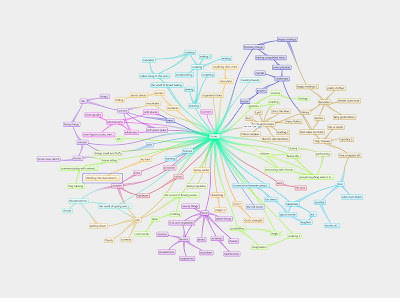
'Ears' and 'tails' were the items that amused me most :o) I have no IDEA what my muse is on about there - though I do have a propensity to greet close friends/family members by nibbling their ears while giving them a hello-hug, so maybe that explains ears??
And 'weather' I could have expanded on for hours... I adore weather. Food could have been expanded too, adding in more tasty goodness... But it was pretty cool to see what appeared :) This one's perhaps not as revealing as some of the other maps (I hate, I fear, I need), but it's fun nonetheless :)
Three weeks ago, I signed up for Holly Lisle's Think Sideways course. It's a six month online course, focusing on writing fiction with the aim of making a living from it - tips and tricks and strategies to get your career going and keep it going.
Three weeks into it, I'm loving it :)
As part of the course, we have weekly 'assignments', and a lot of people on the Think Sideways forums have been sharing their assignments for week two. I was kinda surprised, as well as interested and excited, in my own results, and I thought - where better to post them than here? :)
The assignment was to create a 'sweet spot map' - a random clustering of the first things that came to mind for each of six prompts: I love, I am drawn to, I get shivers from, I fear, I hate, I need. These are things that come (if you're really working 'randomly') from your subconscious, and are things that you can put into your writing no matter what genre you're writing in that will make it resonate with you; these are the things in your writing that are you.
I made my original map as recommended on six scrappy pieces of paper taped together - and I adore it, and am now carrying it everywhere with me, adding to it as things occur to me. However, for ease of viewing, I've used a nifty little program called Cayra, so that you won't have to decode my handwriting ;)
It's taking me a while to type the stuff in and detangle the resulting webby nets, so I'll pop the six maps up over the next few weeks. But first, for your viewing pleasure, an insight into what my subconscious - my dear little Muse *cough cough* - loves.

'Ears' and 'tails' were the items that amused me most :o) I have no IDEA what my muse is on about there - though I do have a propensity to greet close friends/family members by nibbling their ears while giving them a hello-hug, so maybe that explains ears??
And 'weather' I could have expanded on for hours... I adore weather. Food could have been expanded too, adding in more tasty goodness... But it was pretty cool to see what appeared :) This one's perhaps not as revealing as some of the other maps (I hate, I fear, I need), but it's fun nonetheless :)
08 August 2008
Welcome To My Sidebar: Write or Right
"An aspiring writer describes the ins and outs of writing, querying, and (we hope!) publishing."
Who: My 'twin', one half of the Twins of Darkness and Good, an aspiring writer who goes by the name of Liana Brooks. Liana writes mostly science fiction, with the odd fantasy piece thrown in. Her work is unashamedly cross genre - expect to find vampires, werewolves, shifters and various forms of 'pathics in her ViS universe, just for a start :)
What: Write or Right is Liana's personal writing blog. She gives updates on her writing progress, makes lots of announcements about competitions and writing opportunities, and offers her own thoughts and comments on the process of writing and most particularly plot formation and idea generation.
Where: Here or here: http://lianabrooks.blogspot.com/
Why: I love this blog not only because it belongs to my twin in the writing world, but because Liana has an awesome sense of humour and an amazing ability to generate unique and awesome ideas. Her posts always make me either laugh or think - often both - and it's a fantastic source of inspiration for science fiction and fantasy ideas. Go, check it out!!
When: Irregularly, but about 4 times per week. Regular posts on Fridays - the Friday Random, which are very enjoyable :o)
Who: My 'twin', one half of the Twins of Darkness and Good, an aspiring writer who goes by the name of Liana Brooks. Liana writes mostly science fiction, with the odd fantasy piece thrown in. Her work is unashamedly cross genre - expect to find vampires, werewolves, shifters and various forms of 'pathics in her ViS universe, just for a start :)
What: Write or Right is Liana's personal writing blog. She gives updates on her writing progress, makes lots of announcements about competitions and writing opportunities, and offers her own thoughts and comments on the process of writing and most particularly plot formation and idea generation.
Where: Here or here: http://lianabrooks.blogspot.com/
Why: I love this blog not only because it belongs to my twin in the writing world, but because Liana has an awesome sense of humour and an amazing ability to generate unique and awesome ideas. Her posts always make me either laugh or think - often both - and it's a fantastic source of inspiration for science fiction and fantasy ideas. Go, check it out!!
When: Irregularly, but about 4 times per week. Regular posts on Fridays - the Friday Random, which are very enjoyable :o)
Subscribe to:
Comments (Atom)
