I'm going to spend the next few posts discussing outlines; appropriate since I'm in the throes thereof. Tune in later for parts two and three.
Hands up who out there is a pantser, who trembles at the very hint of an outline, who cries at being asked to structure their first draft, and who would rather die than write a story that's already been written (in outline form)?
Yes? Well, you'll sympathise with my topic today.
There are, of course, as many ways to write as there are people who write (and probably more, since all my novels so far have demanded that they be written differently), and outlines are one of the more fraught topics of conversation. To love them, or hate them? To use them or abuse them? To write them all out and then conveniently ignore them while you write, making you wonder why you bothered in the first place?
I've had experiences at all ends of the spectrum (yes, all; this is more than a linear scale!), and today I'm going to talk about my worst outlining experience ever. It was a play, not a novel, but the essential principles remain the same. This play was written for a specific purpose, to be performed at a specific time to a specific audience - and things just keep getting more specific. Initially, I was told the topic of the play. Then I was told the basic story line it would follow (a retelling of a well-known (in those circles) story).
All good, all fine thus far. I could work with a general plot, and still interpret and embellish and dramatise, and all would be well.
Except. Specific. The commissioner of the play is a very specific fellow, and soon I not only had a rough plotline I had to follow, but a schedule that involved certain events happening on certain nights, bits of dialogue that needed to be included, set ideas that had to be worked in, and a particular number of characters.
I reeled. I floundered. I wrote the play, and every single person who worked in it (who have all performed plays of mine in similar contexts before) unanimously agreed it was the worst play I'd ever written. I pretty much refused to put my name to it.
Now, I firmly believe that outlining is a Good Thing, that it's *le gasp* necessary and can save a whole bunch of headaches (see forthcoming post!). So what went wrong here?
Easy: too much outlining, and from an externally imposed source. Now, it might be really tempting for you to sit back and say - well, that's fine! I'm never going to write on request like that, and I'll decide what I want to write, and everthing will be great! So I'm sorry about your problems, but they don't apply to me.
Except, they do.
Externally imposed outlining doesn't just happen when other people impose things on you; on the whole, we're pretty good at doing it to ourselves. Fantasy and sci fi writers are particularly notorious for this, mostly because we're the ones who tend to go overboard on the whole worldbuilding thing. We spend days/weeks/months/years building our world before we ever put pen to paper for the actual story, which means that by the time we come to write, there are a whole bunch of 'external' factors dictating how the story should go.
Forced-march plotting, I believe it's called. It's where the plot happens for no reason other than that it must, and I'm guilty as heck of it even in writing that I do for myself. I've decided how I want the story to end up, what the steps ought to be to get the characters from A to Z, and by hook or by crook, those are the steps they'll take, character veracity be hanged.
It leads to a story that's dry and often illogical - and it's all to easy to fall into the forced-march trap. I did, in January, with the first version of the rewritten Act One of Jesscapades. Characters come across as stupid and unmotivated, plot events happen by coincedence and seem too convenient, and the whole story feels dry and flaky. Story dandruff? Don't let it happen to you!
Combat FMP (forced-march plotting) by taking a long hard look at your characters. Is x plot point something they would really do in that situation? If not, can you switch out the plot point for something else? Can you give them a plausible excuse for doing something out of character? Or even better, can you build up to this and motivate them so Plot Point X comes across not as an anomaly, but as a new and exciting facet of the character, making them a deeper, rounder, more real character?
So, Planners beware: outlines are tricksy little beasts that will turn on you as soon as look at you. Don't let them take control.
Pansters of the world unite!
Anyone else have outlining horror stories to share? O:) :D
Showing posts with label outlines. Show all posts
Showing posts with label outlines. Show all posts
15 March 2011
16 November 2009
Trying Something New
So, long-time reader of this blog will know that for me, the first 7ish chapters of a novel usually fly past. It's when I hit chapter 8 that I hit trouble. (I can't find a post to back this up, but trust me: it's true. It's also the reason why I have so many first-seven-chapters of novels littering my harddrive o.0)
How Not To Take Over The World, the spoofy fantasy novel that I'm writing for NaNoWriMo, is running fit and true to form: the first 8 chapters flew past in a blur of giggles and glee... And then I hit chapter 9.
Slam. Right into that wall.
*pokes it*
So, what do I do when all the impetus that keeps my work going come screeching to a halt? When my plot starts getting Serious and I have to actually think about keeping the characters within the bounds of the story, when I have to start saying no to random fun tangents and basically my whole self-esteem as a writing drops through the floor - Can I do this? Can I really tie all this squee together into something coherent? How can I live up to the standard of the first few chapters, which are funny?
Usually, when I write a novel, I outline thusly: I start the novel with a reasonable idea of how it will end, and some inklings as to what the midpoint change will be. I write a chapter. I get ideas, and I write the next chapter. For the first 7-8, I'm usually outlining a chapter or two ahead as the current scenes spark ideas for new ones.
Then I hit the end of act one: The Wall. Ordinarily, it's about now that the plot starts coming together, I see how things are going to fit into the storyline, and I'll outline to about the middle of the novel. As I draw closer to the middle, I'll outline about that number of chapters again further on - so I'm always say ten chapters ahead with the outline.
When I hit the middle, or just past, I'll have an outline nearly to the end anyway, so I'll usually sit down and outline all the way to the end at this point.
Note that when I say outline, I mean the Line For Scene (L4S) method: just a single sentence describing the main conflict of the scene - although sometimes I'll throw in some dialogue too if it comes to me ;)
That's how I'd usually do it; and usually, I'd struggle through the middle with none of the delight that I had in the first chapters, plodding onward because that's what my outline tells me to do. I'd finish the book, but by then I'd be sick of it, because I knew everything that was going to happen and nothing surprised me. I didn't let anything surprise me.
Which is totally contradictory to everything I've learned and know about writing. We write to have fun, we write to discover, to be surprised and delighted - and by outlining as I do, for me, it kills the joy of the spontaneity that I find in the first handful of chapters. I say "for me", because some people do outline comprehensively, and it works for them. Good on them, I say :)
But this time, I'm going to try something different. It's NaNo, after all, and setting yourself free from your usual rules and boundaries is practically in the rules.
This time, I'm going to remember everything I learned in the Think Sideways course about creating surprises that surprise even me; about 'leaving toys on the floor' as I write for my subconscious to pick up later and turn into twists and turns.
I'm also going to remember everything I'd learned recently by experience about listening to my characters. When I get stuck, I'm going to resist the temptation to plot and outline my way through it by logic; people aren't always logical, after all. Instead, I'm going to sit back, visualise my character and where they are, and ask them what they're doing.
They'll show me; they already have.
And hopefully, this will allow me to hold onto that feeling of spontaneity and delight that's seen me through the first 8 chapters - though of course, I still worry that the story will suck :D hehe.
So, NaNo. I cracked 25k yesterday, and am pretty much on target to finish 50k comfortably in the month. Who else is doing it? How are you going? What have you learned so far? And no, you can't say nothing - because every time we write, we learn something, even if it's only to never, ever use second person omniscient tense while utilising a backwards timeframe again O:) :D
How Not To Take Over The World, the spoofy fantasy novel that I'm writing for NaNoWriMo, is running fit and true to form: the first 8 chapters flew past in a blur of giggles and glee... And then I hit chapter 9.
Slam. Right into that wall.
*pokes it*
So, what do I do when all the impetus that keeps my work going come screeching to a halt? When my plot starts getting Serious and I have to actually think about keeping the characters within the bounds of the story, when I have to start saying no to random fun tangents and basically my whole self-esteem as a writing drops through the floor - Can I do this? Can I really tie all this squee together into something coherent? How can I live up to the standard of the first few chapters, which are funny?
Usually, when I write a novel, I outline thusly: I start the novel with a reasonable idea of how it will end, and some inklings as to what the midpoint change will be. I write a chapter. I get ideas, and I write the next chapter. For the first 7-8, I'm usually outlining a chapter or two ahead as the current scenes spark ideas for new ones.
Then I hit the end of act one: The Wall. Ordinarily, it's about now that the plot starts coming together, I see how things are going to fit into the storyline, and I'll outline to about the middle of the novel. As I draw closer to the middle, I'll outline about that number of chapters again further on - so I'm always say ten chapters ahead with the outline.
When I hit the middle, or just past, I'll have an outline nearly to the end anyway, so I'll usually sit down and outline all the way to the end at this point.
Note that when I say outline, I mean the Line For Scene (L4S) method: just a single sentence describing the main conflict of the scene - although sometimes I'll throw in some dialogue too if it comes to me ;)
That's how I'd usually do it; and usually, I'd struggle through the middle with none of the delight that I had in the first chapters, plodding onward because that's what my outline tells me to do. I'd finish the book, but by then I'd be sick of it, because I knew everything that was going to happen and nothing surprised me. I didn't let anything surprise me.
Which is totally contradictory to everything I've learned and know about writing. We write to have fun, we write to discover, to be surprised and delighted - and by outlining as I do, for me, it kills the joy of the spontaneity that I find in the first handful of chapters. I say "for me", because some people do outline comprehensively, and it works for them. Good on them, I say :)
But this time, I'm going to try something different. It's NaNo, after all, and setting yourself free from your usual rules and boundaries is practically in the rules.
This time, I'm going to remember everything I learned in the Think Sideways course about creating surprises that surprise even me; about 'leaving toys on the floor' as I write for my subconscious to pick up later and turn into twists and turns.
I'm also going to remember everything I'd learned recently by experience about listening to my characters. When I get stuck, I'm going to resist the temptation to plot and outline my way through it by logic; people aren't always logical, after all. Instead, I'm going to sit back, visualise my character and where they are, and ask them what they're doing.
They'll show me; they already have.
And hopefully, this will allow me to hold onto that feeling of spontaneity and delight that's seen me through the first 8 chapters - though of course, I still worry that the story will suck :D hehe.
So, NaNo. I cracked 25k yesterday, and am pretty much on target to finish 50k comfortably in the month. Who else is doing it? How are you going? What have you learned so far? And no, you can't say nothing - because every time we write, we learn something, even if it's only to never, ever use second person omniscient tense while utilising a backwards timeframe again O:) :D


08 December 2008
The Sentence
So, two weeks ago I did a post on outlining, and how it works for me. We had a lovely discussion in the comments about the pros and cons of outlining, and the lovely Liana (Just_Me) made this comment:
"My other problem with plotting is that I move to the logical next step. Which doesn't always have tension. It's just the step that makes sense."
This is precisely one of the reasons why I love the line-for-scene method of outlining: you can see at a glance where the tension is lacking, and fix it before you write the thousands of words that said scene entails. The techniques I'm about to divulge come to you directly from the Think Sideways course that I love so much :o), specifically lessons 4 (How to Recognise and Build On Good Ideas) and 8 (How to Plan Your Project Without Killing Your Story).
See, the line-for-scene (hereafer L4S) method of outlining uses one very special tool: The Sentence. Not, 'the sentence', which is just a collect of words in approximately the order subject-verb-object, but 'The Sentence', capital letters. The Sentence is a powerful tool at all levels of storying: it makes a killer of an opening to a query letter, and by using The Sentence, you can tell immediately if your story or scene has the necessary ingredients for 'Good'.
So, what are these necessary ingredients?
In the words of Holly Lisle, "a protagonist with a compelling need, set against an antagonist with a compelling need, doing interesting things in interesting places, with something slightly askew."
For a good story, the necessary elements are:
* A protagonist with a need. If there is no protagonist, there is no one for the reader to care about, and if there is no one for the reader to care about, there is no reason for them to read the story. If the protagonist doesn't have a driving need, something that compels their actions, they are likely to be flat, boring, unrealistic, or all of the above. Protagonists do not have to be human, they do not have to be people, and they do not even have to be sentient. Inanimate objects can and do work. Needs to not have to be big, or emotional: a character who is driven by the need to observe can, done correctly, be just as interesting as a character driven by the need for revenge.
* An antagonist with a need. This one gets even more loose in terms of definition: antagonists can be situations, events, catastrophes like a hurricane or a battle. Any object that stands in the way of the protagonist's goal is an antagonist. This means you can be a bit creative with the whole 'need' thing: a storm's 'need' is to be a storm, a battle's 'need' is to be fought and won, etc. The essential thing to remember here is conflict: whatever the antagonists is, and whatever their 'need', it must be in conflict with the protagonist and their need.
* Interesting things in interesting places. Yes, the setting can be contemporary, here and now; in this case the onus falls on the 'things' (the conflict) to bear the weight of the interest. Yes, the conflict can be small, quiet, and seemingly unimportant - if the setting is able to take the weight of interest.
* Something askew, aka a twist. Something in your sentence, your story, your scene, needs to be not quite would the average person would have expected: if nothing happens that the reader did not expect, what's the point of reading?
By using this method of outlining (whether you choose to outline at the outset, part way through, or for revision, and whether you outline all the scenes, most of the scenes, or just a few of the high points) and subsequently dissecting your Sentences, it's dead easy to see where your conflict is - and where it isn't. And for the places where it isn't, The Sentence can be a great tool to help you introduce some.
Some examples, noting that when doing this for scenes you don't need to be quite as intensive as when you're doing it for a story - Holly calls it 'The Sentence Lite' :) The following are sentences I used in outlining The Project.
1) Heather and Andrew search the canyon for people, and can't find anything except a strange flickering movement that only Heather can see.
Protag: check. Heather and Andrew. It's not stated explicitly here, but their need is to find the People.
Antag: mm, iffy. Maybe the canyon, the setting - the fact that it's preventing them from finding the people.
Interesting things, interesting places: and here's where it falls down. What are they doing? Uh, wandering around looking for something. Wow. Great conflict there. Where is it? Well, to be fair, the canyon in slightly interesting, since it's known that something weird it up with it, but as it comes across here - buh-bow. Fail.
Twist: eh, sort of. The fact that only Heather can see this strange flickering movement is a bit twisty, but not brilliant.
2) They break into Angela's office and Heather recognises the fish by the door as her father's electronic fish.
Protag: Heather & co. At this point, following on from the previous scene in the book, her need is to find out who's torturing the People.
Antag: negative. I know that it's both the building they're in (trying to break in whilst avoiding capture, etc is a big barrier) and the person that's responsible for the torture, but an antagonist is completely absent from this sentence.
Interesting things/places: breaking in is pretty interesting. Recognising the electronic fish, in the context of the story, is VERY interesting. So this isn't too bad. It could have a better sense of setting, but it is only Sentence Lite after all.
Twist: this chapter is called 'It's All In The Fish' for a reason: the fish are a very major twist.
I could continue - and, if I were planning to continue with The Project, I would, because it's a very valuable exercise - but for now, how about The Sentence for a full story? A friend of mine was kind enough to donate a sentence she's working on for me to dissect.
A double-crossed CIA agent fights to save himself from terrorists and his own untrusting heart.
Okay. We have a protag: the CIA agent. We have a hint at his needs: he's been double-crossed, and needs to save himself. So far, so good.
We have an antag: the terrorists. There's not really any hint of their needs, apart from the implied assumption that they're after the CIA agent, and that they're terrorists. Not terrible, though.
Interesting things/places: well, it's a CIA agent and a bunch of terrorists :o) Interesting things are bound to happen. There's not really any sense of place, though, other than the fact that we can assume it's a reasonably contemporary world.
Twist: assumedly the fact that what the CIA agent must really save himself from is "his own untrusting heart".
This is a solid basis for The Sentence, but it could be tightened, I feel, in the areas of place and twist - and a sense of the terrorists' motives would be good, too. It's a lot to pack in to one, less-than-30-word sentence, I know - but that's the point. This sentence, as it stands, is fine. You can settle for fine.
But you can also shoot for brilliance.
Here are a couple of my own (not necessarily brilliant!) suggestions to close. Bear in mind I've only read the first few chapters, so I may be way off base :D Please feel free to leave your opinions and suggestions in the comments :)
Deep in the South American jungle, a double-crossed CIA agent fights terrorists for his life - and his mistrust for another chance at love.
Fighting for his life against terrorists in the South American jungle, a double-crossed CIA agent is drawn into a bigger battle: the one for his heart.
His (own) untrusting heart proves a bigger obstacle to a double-crossed CIA agent, fighting for his life in the steamy South American jungle.
Even with terrorists hot on his trail through the South Amercian jungle, a double-crossed CIA agent fights a more important battle against his own mistrusts and (something).
"My other problem with plotting is that I move to the logical next step. Which doesn't always have tension. It's just the step that makes sense."
This is precisely one of the reasons why I love the line-for-scene method of outlining: you can see at a glance where the tension is lacking, and fix it before you write the thousands of words that said scene entails. The techniques I'm about to divulge come to you directly from the Think Sideways course that I love so much :o), specifically lessons 4 (How to Recognise and Build On Good Ideas) and 8 (How to Plan Your Project Without Killing Your Story).
See, the line-for-scene (hereafer L4S) method of outlining uses one very special tool: The Sentence. Not, 'the sentence', which is just a collect of words in approximately the order subject-verb-object, but 'The Sentence', capital letters. The Sentence is a powerful tool at all levels of storying: it makes a killer of an opening to a query letter, and by using The Sentence, you can tell immediately if your story or scene has the necessary ingredients for 'Good'.
So, what are these necessary ingredients?
In the words of Holly Lisle, "a protagonist with a compelling need, set against an antagonist with a compelling need, doing interesting things in interesting places, with something slightly askew."
For a good story, the necessary elements are:
* A protagonist with a need. If there is no protagonist, there is no one for the reader to care about, and if there is no one for the reader to care about, there is no reason for them to read the story. If the protagonist doesn't have a driving need, something that compels their actions, they are likely to be flat, boring, unrealistic, or all of the above. Protagonists do not have to be human, they do not have to be people, and they do not even have to be sentient. Inanimate objects can and do work. Needs to not have to be big, or emotional: a character who is driven by the need to observe can, done correctly, be just as interesting as a character driven by the need for revenge.
* An antagonist with a need. This one gets even more loose in terms of definition: antagonists can be situations, events, catastrophes like a hurricane or a battle. Any object that stands in the way of the protagonist's goal is an antagonist. This means you can be a bit creative with the whole 'need' thing: a storm's 'need' is to be a storm, a battle's 'need' is to be fought and won, etc. The essential thing to remember here is conflict: whatever the antagonists is, and whatever their 'need', it must be in conflict with the protagonist and their need.
* Interesting things in interesting places. Yes, the setting can be contemporary, here and now; in this case the onus falls on the 'things' (the conflict) to bear the weight of the interest. Yes, the conflict can be small, quiet, and seemingly unimportant - if the setting is able to take the weight of interest.
* Something askew, aka a twist. Something in your sentence, your story, your scene, needs to be not quite would the average person would have expected: if nothing happens that the reader did not expect, what's the point of reading?
By using this method of outlining (whether you choose to outline at the outset, part way through, or for revision, and whether you outline all the scenes, most of the scenes, or just a few of the high points) and subsequently dissecting your Sentences, it's dead easy to see where your conflict is - and where it isn't. And for the places where it isn't, The Sentence can be a great tool to help you introduce some.
Some examples, noting that when doing this for scenes you don't need to be quite as intensive as when you're doing it for a story - Holly calls it 'The Sentence Lite' :) The following are sentences I used in outlining The Project.
1) Heather and Andrew search the canyon for people, and can't find anything except a strange flickering movement that only Heather can see.
Protag: check. Heather and Andrew. It's not stated explicitly here, but their need is to find the People.
Antag: mm, iffy. Maybe the canyon, the setting - the fact that it's preventing them from finding the people.
Interesting things, interesting places: and here's where it falls down. What are they doing? Uh, wandering around looking for something. Wow. Great conflict there. Where is it? Well, to be fair, the canyon in slightly interesting, since it's known that something weird it up with it, but as it comes across here - buh-bow. Fail.
Twist: eh, sort of. The fact that only Heather can see this strange flickering movement is a bit twisty, but not brilliant.
2) They break into Angela's office and Heather recognises the fish by the door as her father's electronic fish.
Protag: Heather & co. At this point, following on from the previous scene in the book, her need is to find out who's torturing the People.
Antag: negative. I know that it's both the building they're in (trying to break in whilst avoiding capture, etc is a big barrier) and the person that's responsible for the torture, but an antagonist is completely absent from this sentence.
Interesting things/places: breaking in is pretty interesting. Recognising the electronic fish, in the context of the story, is VERY interesting. So this isn't too bad. It could have a better sense of setting, but it is only Sentence Lite after all.
Twist: this chapter is called 'It's All In The Fish' for a reason: the fish are a very major twist.
I could continue - and, if I were planning to continue with The Project, I would, because it's a very valuable exercise - but for now, how about The Sentence for a full story? A friend of mine was kind enough to donate a sentence she's working on for me to dissect.
A double-crossed CIA agent fights to save himself from terrorists and his own untrusting heart.
Okay. We have a protag: the CIA agent. We have a hint at his needs: he's been double-crossed, and needs to save himself. So far, so good.
We have an antag: the terrorists. There's not really any hint of their needs, apart from the implied assumption that they're after the CIA agent, and that they're terrorists. Not terrible, though.
Interesting things/places: well, it's a CIA agent and a bunch of terrorists :o) Interesting things are bound to happen. There's not really any sense of place, though, other than the fact that we can assume it's a reasonably contemporary world.
Twist: assumedly the fact that what the CIA agent must really save himself from is "his own untrusting heart".
This is a solid basis for The Sentence, but it could be tightened, I feel, in the areas of place and twist - and a sense of the terrorists' motives would be good, too. It's a lot to pack in to one, less-than-30-word sentence, I know - but that's the point. This sentence, as it stands, is fine. You can settle for fine.
But you can also shoot for brilliance.
Here are a couple of my own (not necessarily brilliant!) suggestions to close. Bear in mind I've only read the first few chapters, so I may be way off base :D Please feel free to leave your opinions and suggestions in the comments :)
Deep in the South American jungle, a double-crossed CIA agent fights terrorists for his life - and his mistrust for another chance at love.
Fighting for his life against terrorists in the South American jungle, a double-crossed CIA agent is drawn into a bigger battle: the one for his heart.
His (own) untrusting heart proves a bigger obstacle to a double-crossed CIA agent, fighting for his life in the steamy South American jungle.
Even with terrorists hot on his trail through the South Amercian jungle, a double-crossed CIA agent fights a more important battle against his own mistrusts and (something).
24 November 2008
Following a Weathered Outline...
So, you'll have to excuse the multitude of puns in today's title O:) Puns, you ask? What puns? Ahh. Bear with me but a moment, and I shall reveal all *looks wise and knowing*
Firstly, following: I'm sure a lot of you are aware, but blogger has developed this nifty little concept called 'following', whereby you can elect to follow a blog and thence have it appear on your blogger dashboard, conveniently letting you check all blogs you're following at once, and see at a glance who's updated and who hasn't. Consider this your official *poke* to FOLLOW MEEEEEEE! :) There's a handy link over there in the sidebar, right below Works In Progress, if you'd like to become a follower.
(As an aside, don't you just love how secret-cult-shall-rule-the-world that sounds? Hello, everyone, this is my blog, and these are my followers......)
Next, weather. This is completely unrelated to the blog, but it's just so jolly unfair I feel compelled to mention it. I live in Australia. AUS-TRA-LI-A. It is November. NO-VEM-BER. This, dear weather gods, means it's nearly Summer. This is NOT the appropriate time to start dumping the best snow of the year. \:|
Right. Which brings me to outlines, and the following of them :D As every tactician knows, no plan survives first contact with the enemy; and as every writer knows, no outline survives first contact with the story.
When I started writing The Project, I had a vague idea of where it was going, and that was all. It didn't matter too much: the entire object of writing it was an exercise in plot, in learning to race from one troublesome situation to whatever problem my muse came up with next. But there came a point when the time travel and multiple subplots got the better of me, and I outlined. Just one sentence per scene, in a pretty little table in a word document.
It was good enough to get me through to over halfway, but naturally, it couldn't remain intact. So, when I decided to start rewriting TP in order to get the characters right, since I knew the plot and twists etc, I broke out my outlining tools to give the book a bit more oomph, and to make sure I had everything covered. Hence, it's my weathered outline ;) It's weathered the storm of most of a first draft, and is still a bit rough (weathered, ha ha) around the edges! Gwa! *is proud of puns* O:)
This is the complete outline:

Yeah, I know, you can't see a thing. If you could, though, what you'd see would be something like this:


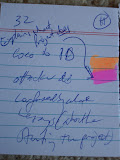


That's nice, you say, but what does it all mean? Well, each card has a sentence on it (roughly; work with me here ;)) that corresponds to a scene. The letter in the circle at the top right of each card is the POV; the green stripe or lack thereof at the top left indicates to me which timeline the card is in (past, present or future). The colours down the right hand side indicate which plot threads the scene relates to, selected from the following:

Don't know if you can read that or not, but it basically says pink is developing sympathy for the girl, blue is solving the mystery (the main thrust of the story), yellow is revealing past events, orange is a third party subplot, and purple is 'Angela', the second POV character.
So, why did I go to all the effort of writing this down on cards, and colour-coding, etc? Isn't that an awful lot of work for something that - again - may not survive first contact?
Well, yes... But no. Writing out the outline like this* has lots of advantages. Firstly, there's the visual aspect - you can see everything at once, all out in front of you, and it's dead easy to pick up the cards and shuffle them around and see what happens to your timeline - and your story. All sorts of connections can be formed that you'd never have found otherwise.
Secondly, you can immediately identify the weak spots in the plot: sentences that drag, that have no conflict, or that are just plain boring are usually indicative of scenes that do the same. Conflict is the meat of any writing, and this is a quick way to spot places you might be lacking.
Thirdly, the whole colour-coordination thing: subplots. Unless you're writing YA, MG, or really short books, you absolutely need subplots. My current wip, Jesscapades, has no less than 11 plot strands at present. And the easiest way I've found to keep track of them all is colour coding. Once again, it's a visual thing: you can see it all there in front of you, and you can tell at a glance how much of the book is devoted to which plot threads, places where perhaps you've ignored a thread for too long, and places where you might be able to introduce a new one - or even ways which you can combine threads if you have too many for the book you're writing. It's also a great way to make sure you've tied up all your threads. That's what the big black dot on card 35 above means: I've tied off plot threads pink and purple.
Not everyone likes outlining, and most outlines end up looking nothing like the finished book. But that doesn't mean there's no use for them, as I hope I've demonstrated. And not only can you use this to do a check of how you're going, getting the cards out and shuffling them around can be a great way to unstick yourself if the story feels like it's getting out of hand; a handful of white squares seems so much more manageable than nebulous story concepts colliding in your head.
So, do you outline? Why or why not? How far do you go? And would you ever consider this method?
* If you're a pantser, who absolutely cannot outline before writing, consider using this method for editing and revising instead. If you're an outliner, you can use this method then too.
Firstly, following: I'm sure a lot of you are aware, but blogger has developed this nifty little concept called 'following', whereby you can elect to follow a blog and thence have it appear on your blogger dashboard, conveniently letting you check all blogs you're following at once, and see at a glance who's updated and who hasn't. Consider this your official *poke* to FOLLOW MEEEEEEE! :) There's a handy link over there in the sidebar, right below Works In Progress, if you'd like to become a follower.
(As an aside, don't you just love how secret-cult-shall-rule-the-world that sounds? Hello, everyone, this is my blog, and these are my followers......)
Next, weather. This is completely unrelated to the blog, but it's just so jolly unfair I feel compelled to mention it. I live in Australia. AUS-TRA-LI-A. It is November. NO-VEM-BER. This, dear weather gods, means it's nearly Summer. This is NOT the appropriate time to start dumping the best snow of the year. \:|
Right. Which brings me to outlines, and the following of them :D As every tactician knows, no plan survives first contact with the enemy; and as every writer knows, no outline survives first contact with the story.
When I started writing The Project, I had a vague idea of where it was going, and that was all. It didn't matter too much: the entire object of writing it was an exercise in plot, in learning to race from one troublesome situation to whatever problem my muse came up with next. But there came a point when the time travel and multiple subplots got the better of me, and I outlined. Just one sentence per scene, in a pretty little table in a word document.
It was good enough to get me through to over halfway, but naturally, it couldn't remain intact. So, when I decided to start rewriting TP in order to get the characters right, since I knew the plot and twists etc, I broke out my outlining tools to give the book a bit more oomph, and to make sure I had everything covered. Hence, it's my weathered outline ;) It's weathered the storm of most of a first draft, and is still a bit rough (weathered, ha ha) around the edges! Gwa! *is proud of puns* O:)
This is the complete outline:

Yeah, I know, you can't see a thing. If you could, though, what you'd see would be something like this:


That's nice, you say, but what does it all mean? Well, each card has a sentence on it (roughly; work with me here ;)) that corresponds to a scene. The letter in the circle at the top right of each card is the POV; the green stripe or lack thereof at the top left indicates to me which timeline the card is in (past, present or future). The colours down the right hand side indicate which plot threads the scene relates to, selected from the following:

Don't know if you can read that or not, but it basically says pink is developing sympathy for the girl, blue is solving the mystery (the main thrust of the story), yellow is revealing past events, orange is a third party subplot, and purple is 'Angela', the second POV character.
So, why did I go to all the effort of writing this down on cards, and colour-coding, etc? Isn't that an awful lot of work for something that - again - may not survive first contact?
Well, yes... But no. Writing out the outline like this* has lots of advantages. Firstly, there's the visual aspect - you can see everything at once, all out in front of you, and it's dead easy to pick up the cards and shuffle them around and see what happens to your timeline - and your story. All sorts of connections can be formed that you'd never have found otherwise.
Secondly, you can immediately identify the weak spots in the plot: sentences that drag, that have no conflict, or that are just plain boring are usually indicative of scenes that do the same. Conflict is the meat of any writing, and this is a quick way to spot places you might be lacking.
Thirdly, the whole colour-coordination thing: subplots. Unless you're writing YA, MG, or really short books, you absolutely need subplots. My current wip, Jesscapades, has no less than 11 plot strands at present. And the easiest way I've found to keep track of them all is colour coding. Once again, it's a visual thing: you can see it all there in front of you, and you can tell at a glance how much of the book is devoted to which plot threads, places where perhaps you've ignored a thread for too long, and places where you might be able to introduce a new one - or even ways which you can combine threads if you have too many for the book you're writing. It's also a great way to make sure you've tied up all your threads. That's what the big black dot on card 35 above means: I've tied off plot threads pink and purple.
Not everyone likes outlining, and most outlines end up looking nothing like the finished book. But that doesn't mean there's no use for them, as I hope I've demonstrated. And not only can you use this to do a check of how you're going, getting the cards out and shuffling them around can be a great way to unstick yourself if the story feels like it's getting out of hand; a handful of white squares seems so much more manageable than nebulous story concepts colliding in your head.
So, do you outline? Why or why not? How far do you go? And would you ever consider this method?
* If you're a pantser, who absolutely cannot outline before writing, consider using this method for editing and revising instead. If you're an outliner, you can use this method then too.
01 October 2008
September: A Month in Review
So, it has been a month of Not Getting Terribly Much Done in the way of writing, but on the other hand it was also the month of Lots of Assessment, and that was mostly all Done, so it's not like I've been slacking :)
While I haven't written much, my word count for the month is more than the month I set my minimum standard by (last December, 6119 words), so I'm happy :)
This month I have:
* Written a total of 6,700 and something words. This has included:
* 3 complete chapters of The Project, plus bits and pieces in other chapters
* The first chapter of (temporary title) Night in the Shards, the second book in my secret assassin series. (No, book one is not written yet *rolls eyes* I'm going to work on it for some of NaNo)
* Some initial work on a non-fic book I'm writing - more on that later this month :)
I have also:
* Submitted a short story to a Christmas anthology
* Begun plotting the first Edge and Gem book, now titled Sanctuary, in preparation for NaNo
* And completely reorganised, sorted, and pared down my stories, creating a new system of tracking progress that's much more efficient, and streamlines the whole process for me :) *happyhappy*
* Oh yeah, and I got an honourable mention in Allegory for Sea Foam and Blood B-)
And now, blessedly, it is October, bringing me one step closer to my longed-for November, which shall contain both NaNoWriMo, and the End of Uni Woes for another four months :) May October fly speedily on shiny gilt wings!
While I haven't written much, my word count for the month is more than the month I set my minimum standard by (last December, 6119 words), so I'm happy :)
This month I have:
* Written a total of 6,700 and something words. This has included:
* 3 complete chapters of The Project, plus bits and pieces in other chapters
* The first chapter of (temporary title) Night in the Shards, the second book in my secret assassin series. (No, book one is not written yet *rolls eyes* I'm going to work on it for some of NaNo)
* Some initial work on a non-fic book I'm writing - more on that later this month :)
I have also:
* Submitted a short story to a Christmas anthology
* Begun plotting the first Edge and Gem book, now titled Sanctuary, in preparation for NaNo
* And completely reorganised, sorted, and pared down my stories, creating a new system of tracking progress that's much more efficient, and streamlines the whole process for me :) *happyhappy*
* Oh yeah, and I got an honourable mention in Allegory for Sea Foam and Blood B-)
And now, blessedly, it is October, bringing me one step closer to my longed-for November, which shall contain both NaNoWriMo, and the End of Uni Woes for another four months :) May October fly speedily on shiny gilt wings!
30 September 2008
Addendum to Think Sideways
Just as an addition to the previous post, if you are considering trying the Think Sideways course, and want more info, Holly has opened one of the student discussion forums (read-only) so that non-members can see what we're getting up to :o) And if you want more general information, you can check out the curriculum and the FAQs , plus a really interesting survey on how much it costs to write a novel, and why learning to generate ideas and plan projects on a deadline is a critical career writer's skill.
And even if you aren't considering signing up, here's a lovely freebie for you - lesson 11, which discusses in detail how to put together the dreaded query letter, proposals, synopses, and editor outlines. Just click here :) (Yes, this is a legal give-away!)
And don't forget to check out my review of month two below :)
And even if you aren't considering signing up, here's a lovely freebie for you - lesson 11, which discusses in detail how to put together the dreaded query letter, proposals, synopses, and editor outlines. Just click here :) (Yes, this is a legal give-away!)
And don't forget to check out my review of month two below :)
01 September 2008
How To Think Sideways
Just a reminder that the How to Think Sideways course (see my review here) is on sale only through this link for this week. There's a new option, too -
You can sign up for the 6-month course, which is US$47 per month.
OR
You can now sign for the course extended over 12 months, which means you're only paying US$23.50 per month.
Obviously it's the same amount total, but as a student I can appreciate that $23.50 makes a much smaller dent in your monthly budget. And don't forget, you can drop out at any time and you will be fully refunded for any lessons in the month that you haven't received yet - meaning that it will cost you $11.75 to test out the course, download lesson one, and see you think it's for you.
Sales go live at 9am Eastern Daylight Time, through this link, and will be open for 7 days. Remember that if you buy through my link, I can offer you a %25 refund once it clears at the end of each month.
If you're wondering what the course covers, this is the curriculum:
Sideways Thinking: Ideas
Week 1: How to Break the Four "Thinking" Barriers to Your Success
Week 2: How to Discover Your Writing "Sweet Spot"
Week 3: How to Generate Ideas On a Deadline
Week 4: How to Recognize and Build On Good Ideas
Sideways Thinking: Project Planning
Week 5: How to Define Your Project's Needs
Week 6: How to Discover (or Create) Your Project's Market
Week 7: How to Develop Your Personal Project System
Week 8: How to Plan Your Project While NOT Killing Your Story
Sideways Thinking: First Chapters
Week 9: How to Write From Inside Your Story
Week 10: How to "Plan" Surprises that Surprise Even You
Week 11: How to Design Compelling Queries, Proposals, and Sample Chapters
Week 12: How to Create, Complicate, and Solve Problems
Sideways Thinking: Middles
Week 13: "Can't I Just Kill Them All?" How to Fall In Love With Your Project A Second Time
Week 14: How to Find and Use Your "Planned" Surprises
Week 15: How to "Hire" Spies, and Why Your Project Needs Them
Week 16: How to Assess Your Progress and Make Mid-Course Corrections
Sideways Thinking: Endings
Week 17: How to Work With Editors, Agents, Marketing Departments, and Artists, and Not Wreck Your Project.
Week 18: How to Find the RIGHT Ending
Week 19: How to Bend Your Plan Without Breaking It
Week 20: How to Write the Ending That Sells the Next Book
Sidways Thinking: Wrap Up/Start Again
Week 21: How to Plan Your Revision
Week 22: How to NOT Fix What Ain't Broken (While Still Fixing What Is)
Week 23v How to Deliver What You Promised and What They Want On Deadline
Week 24: How to NOT Be a One-Book Wonder---Learn to Produce Repeatable Results
How to Think Sideways: Career Survival Training for Writers.
You can sign up for the 6-month course, which is US$47 per month.
OR
You can now sign for the course extended over 12 months, which means you're only paying US$23.50 per month.
Obviously it's the same amount total, but as a student I can appreciate that $23.50 makes a much smaller dent in your monthly budget. And don't forget, you can drop out at any time and you will be fully refunded for any lessons in the month that you haven't received yet - meaning that it will cost you $11.75 to test out the course, download lesson one, and see you think it's for you.
Sales go live at 9am Eastern Daylight Time, through this link, and will be open for 7 days. Remember that if you buy through my link, I can offer you a %25 refund once it clears at the end of each month.
If you're wondering what the course covers, this is the curriculum:
Sideways Thinking: Ideas
Week 1: How to Break the Four "Thinking" Barriers to Your Success
Week 2: How to Discover Your Writing "Sweet Spot"
Week 3: How to Generate Ideas On a Deadline
Week 4: How to Recognize and Build On Good Ideas
Sideways Thinking: Project Planning
Week 5: How to Define Your Project's Needs
Week 6: How to Discover (or Create) Your Project's Market
Week 7: How to Develop Your Personal Project System
Week 8: How to Plan Your Project While NOT Killing Your Story
Sideways Thinking: First Chapters
Week 9: How to Write From Inside Your Story
Week 10: How to "Plan" Surprises that Surprise Even You
Week 11: How to Design Compelling Queries, Proposals, and Sample Chapters
Week 12: How to Create, Complicate, and Solve Problems
Sideways Thinking: Middles
Week 13: "Can't I Just Kill Them All?" How to Fall In Love With Your Project A Second Time
Week 14: How to Find and Use Your "Planned" Surprises
Week 15: How to "Hire" Spies, and Why Your Project Needs Them
Week 16: How to Assess Your Progress and Make Mid-Course Corrections
Sideways Thinking: Endings
Week 17: How to Work With Editors, Agents, Marketing Departments, and Artists, and Not Wreck Your Project.
Week 18: How to Find the RIGHT Ending
Week 19: How to Bend Your Plan Without Breaking It
Week 20: How to Write the Ending That Sells the Next Book
Sidways Thinking: Wrap Up/Start Again
Week 21: How to Plan Your Revision
Week 22: How to NOT Fix What Ain't Broken (While Still Fixing What Is)
Week 23v How to Deliver What You Promised and What They Want On Deadline
Week 24: How to NOT Be a One-Book Wonder---Learn to Produce Repeatable Results
How to Think Sideways: Career Survival Training for Writers.
01 July 2008
June in Review
So, happy July everyone! Already - can you believe it? I'm not sure I can. The year is half over, and it feels like it's only just begun.
Anyway. What did I accomplish in this last month of the first half of the year? Let's have a look:
* Finished 1 short story, Not Fantasy. Would like to have done more, but that's okay. It's been a busy month.
* Made two submissions, SFB and Shoe. SFB required MASSIVE rewrites to get it to a sub-able stage, and I'm awfully proud of how it's turned out :)
* Very, very nearly made my goal of 15k of writing, almost all of which was done on The Project.
* Outlined a story that's been bouncing around for a while, temporarily titled Fairy Tale Ending.
* Finally, after much struggle and heartache, pegged down an outline for The Project. Am immensely happy about this.
* Began a new play, Where Your Treasure Is.
As for the year as a whole, I'm rather proud of the work that I've done so far. I think I've come quite a long way from the writer I was at the end of December - some of the highlights being the completed first draft of my first ever novel, To Be An Evil Overlord... and my entry into the world of submissions - thus far I've made 5 submissions of plays and short stories :)
I've learnt important things about structure, I'm slowly learning to pare back my overwriting, and I've managed to write more than one short story that has not only stayed short, but that I'm actually quite proud of. My total word count for the year so far is nearly 74,000 words, which is fast approaching last year's total of 102,000, which included 50,000 for nano in November. I've got plans for Nano, outlines for novels, I'm learning to recognise which stories will work and which won't, and I've discovered that I really do have something to say after all - to which end I've started and been running with reasonable success (I think ;)) this lovely blog (yes, despite the archive record, this blog was only started at the very beginning of the year).
So, what would I like to achieve in the second half of the year?
* 2 submissions per month, which is what I've so far been achieving since I began submitting in late April.
* Finish and complete at least one revision of The Project. I'm working on a TP blitz at the moment and hope to have a draft done in mid-August.
* Pare back my writing even more - stop over-writing - learn to recognise what is significant to the story, and what is not.
* Win Nano again. I'm fairly sure I'll be starting my mid-grade fantasy series for this, as it will be a big incentive to actually be able to complete a novel in under 50k.
I'm sure I'll think of more goals month-by-month, but for now, those are the big things.
And more than anything, I hope I'll continue to grow both as a writer and as a person, and that I will never lose sight of the bigger picture and what I have to say.
Thanks to all of you who read my often-rambly comments here. Your support and comments make this endeavour worthwhile :)
Anyway. What did I accomplish in this last month of the first half of the year? Let's have a look:
* Finished 1 short story, Not Fantasy. Would like to have done more, but that's okay. It's been a busy month.
* Made two submissions, SFB and Shoe. SFB required MASSIVE rewrites to get it to a sub-able stage, and I'm awfully proud of how it's turned out :)
* Very, very nearly made my goal of 15k of writing, almost all of which was done on The Project.
* Outlined a story that's been bouncing around for a while, temporarily titled Fairy Tale Ending.
* Finally, after much struggle and heartache, pegged down an outline for The Project. Am immensely happy about this.
* Began a new play, Where Your Treasure Is.
As for the year as a whole, I'm rather proud of the work that I've done so far. I think I've come quite a long way from the writer I was at the end of December - some of the highlights being the completed first draft of my first ever novel, To Be An Evil Overlord... and my entry into the world of submissions - thus far I've made 5 submissions of plays and short stories :)
I've learnt important things about structure, I'm slowly learning to pare back my overwriting, and I've managed to write more than one short story that has not only stayed short, but that I'm actually quite proud of. My total word count for the year so far is nearly 74,000 words, which is fast approaching last year's total of 102,000, which included 50,000 for nano in November. I've got plans for Nano, outlines for novels, I'm learning to recognise which stories will work and which won't, and I've discovered that I really do have something to say after all - to which end I've started and been running with reasonable success (I think ;)) this lovely blog (yes, despite the archive record, this blog was only started at the very beginning of the year).
So, what would I like to achieve in the second half of the year?
* 2 submissions per month, which is what I've so far been achieving since I began submitting in late April.
* Finish and complete at least one revision of The Project. I'm working on a TP blitz at the moment and hope to have a draft done in mid-August.
* Pare back my writing even more - stop over-writing - learn to recognise what is significant to the story, and what is not.
* Win Nano again. I'm fairly sure I'll be starting my mid-grade fantasy series for this, as it will be a big incentive to actually be able to complete a novel in under 50k.
I'm sure I'll think of more goals month-by-month, but for now, those are the big things.
And more than anything, I hope I'll continue to grow both as a writer and as a person, and that I will never lose sight of the bigger picture and what I have to say.
Thanks to all of you who read my often-rambly comments here. Your support and comments make this endeavour worthwhile :)
11 March 2008
Photos
Finally, I have located batteries, the camera AND the card reader, all in the appropriate sequence and at about the same time.
Hence, I can now present for your viewing pleasure, pictures of my lovely post-it notes.
First, the BG plotting:


And photos of the TBAEO edit...


In accordance with Holly Lisle's One Pass Revision technique, green scenes need editing for flow etc only; yellow have at least one major plot point that needs to be changed/added/deleted; orange scenes need major reconstruction; and bright pink scenes are brand new scenes that need to be written.
Pale pink ones are ones that are in the first draft but that I think won't make it to the revised version.
As you can see, there is a surprisingly high proportion of green and yellow post-its, which I find extremely pleasing :) And the little tags are notes to myself - dialogue to include in scenes, thoughts about changing the order of scenes, etc.
I must say, this whole process has been an absolute blast :D Things like structure appear so much more easily when I have the frame of the first draft to work with, and drawing out and adding in subplot that relate to the themes of the novel - primarily acceptance, in the case of TBAEO - well, it's dead easy to see how they slot in when I see it all there in front of me like this :) I likes muchly.
As a final note, some observant readers may notice the gap between the rest of the TBAEO post-its and the final three green ones - that's because there's another scene before those that I wasn't sure if I wanted to change or not. I've decided now, and once I'm allowed to play again (once uni work is done) I'll dig out the post-its and fix up that final scene :)
Well, that's it for now. I hope this has been interesting for you! :)
Why can't first drafts be this fun?!
Hence, I can now present for your viewing pleasure, pictures of my lovely post-it notes.
First, the BG plotting:


And photos of the TBAEO edit...


In accordance with Holly Lisle's One Pass Revision technique, green scenes need editing for flow etc only; yellow have at least one major plot point that needs to be changed/added/deleted; orange scenes need major reconstruction; and bright pink scenes are brand new scenes that need to be written.
Pale pink ones are ones that are in the first draft but that I think won't make it to the revised version.
As you can see, there is a surprisingly high proportion of green and yellow post-its, which I find extremely pleasing :) And the little tags are notes to myself - dialogue to include in scenes, thoughts about changing the order of scenes, etc.
I must say, this whole process has been an absolute blast :D Things like structure appear so much more easily when I have the frame of the first draft to work with, and drawing out and adding in subplot that relate to the themes of the novel - primarily acceptance, in the case of TBAEO - well, it's dead easy to see how they slot in when I see it all there in front of me like this :) I likes muchly.
As a final note, some observant readers may notice the gap between the rest of the TBAEO post-its and the final three green ones - that's because there's another scene before those that I wasn't sure if I wanted to change or not. I've decided now, and once I'm allowed to play again (once uni work is done) I'll dig out the post-its and fix up that final scene :)
Well, that's it for now. I hope this has been interesting for you! :)
Why can't first drafts be this fun?!
06 February 2008
'Black Gates' Wins Out in the Portalverse...
So, after all my fluffing around, it seems The Black Gates has finally won over Logan in the 'Which Book Gets Written Next' competition.
Why?
Simple. It may not have as complete an outline, but it does have that one thing that Logan sorely lacks - world-building. And now, also, a beginning, which came to me last night as I lay in bed struggling to sleep. Teaser, anyone?
Athara tensed under the blankets and strained her ears in the darkness. Was that the gate?
I'm horrified by the fact that it begins with the MC waking up, but at this stage, it'll just have to cope. Besides, it's not waking up so much as being woken up. And that's completely different, right? *sheepish grin* At least it has a beginning now.
In other news, my universe finally has a name. A nickname, anyway, something quick which I can use to refer to it. It came to me this morning as I was driving to work.
Yesterday, I spent a lot of time reading agent Kirsten Nelson's blog, and subsequently doing some actual agent research (cue scary music... dun dun dun...). It was interesting, though I bemoan the fact that so many more US agents make themselves accessible through the web - I'm yet to find a single Australian agency that even lists bios for its agents :\
ANYway. My universe.
Somewhere in the mountains of advice I read yesterday, an agent spoke of a story she'd taken on - to her suprise, a 'portal story'.
*shock* and *surprise* on my part. Prophecies? Chosen Ones? Sure, they're overdone in fantasy, that's a no-brainer.
But portals?
Well, yes. I suppose so.*
*cringes*
Any of you that know the background that ties my stories together will understand that this is crushing news for me. (Though I don't really care; see footnote below). In my universe, portals abound. They're pretty much a staple, you could say.
And all this rushed through my head this morning as I drove, distracting me from focussing on the on-coming traffic (O:) don't tell my father!)... and the perfect name appeared.
My universe is, officially, the Portalverse.
:D
*(A large part of me wants badly to argue that they're only as overdone in fantasy as space ships are in science fiction... People need to travel after all. But is this self-defence or logic at work here? Who's to say...)
P.S. Say hello to my hundredth post. Hoorah! Aren't I verbose *beams*
Why?
Simple. It may not have as complete an outline, but it does have that one thing that Logan sorely lacks - world-building. And now, also, a beginning, which came to me last night as I lay in bed struggling to sleep. Teaser, anyone?
Athara tensed under the blankets and strained her ears in the darkness. Was that the gate?
I'm horrified by the fact that it begins with the MC waking up, but at this stage, it'll just have to cope. Besides, it's not waking up so much as being woken up. And that's completely different, right? *sheepish grin* At least it has a beginning now.
In other news, my universe finally has a name. A nickname, anyway, something quick which I can use to refer to it. It came to me this morning as I was driving to work.
Yesterday, I spent a lot of time reading agent Kirsten Nelson's blog, and subsequently doing some actual agent research (cue scary music... dun dun dun...). It was interesting, though I bemoan the fact that so many more US agents make themselves accessible through the web - I'm yet to find a single Australian agency that even lists bios for its agents :\
ANYway. My universe.
Somewhere in the mountains of advice I read yesterday, an agent spoke of a story she'd taken on - to her suprise, a 'portal story'.
*shock* and *surprise* on my part. Prophecies? Chosen Ones? Sure, they're overdone in fantasy, that's a no-brainer.
But portals?
Well, yes. I suppose so.*
*cringes*
Any of you that know the background that ties my stories together will understand that this is crushing news for me. (Though I don't really care; see footnote below). In my universe, portals abound. They're pretty much a staple, you could say.
And all this rushed through my head this morning as I drove, distracting me from focussing on the on-coming traffic (O:) don't tell my father!)... and the perfect name appeared.
My universe is, officially, the Portalverse.
:D
*(A large part of me wants badly to argue that they're only as overdone in fantasy as space ships are in science fiction... People need to travel after all. But is this self-defence or logic at work here? Who's to say...)
P.S. Say hello to my hundredth post. Hoorah! Aren't I verbose *beams*
31 January 2008
Sometimes It Comes... And It Isn't What You Expected
I know, I know, I'm spamming you this week. I'm sorry. Hopefully, you'll cope.
Sometimes, the book you plan to write isn't the one that wants to be written. I sat down tonight, prepared to force myself to begin outlining The Black Gates.
Instead, I now have a 1300+ word outline for (temporary title) Logan's Prize. Stupid title, since he doesn't have a prize. Maybe I'll just nickname it Logan.
This story is a bit of history for The Black Gates; I've known the general gist of it for months now, but the story just came to me, a few weeks ago, first act complete, just like that. I could see the scenes vividly in my mind, and I just knew it would work.
I typed it up...
And then I lost it. I've spend the last two days scouring my home computer, my work computer, my email accounts and my notebooks... All to no avail.
So tonight, instead of outlining The Black Gates, I sat down to write what I knew about Logan. And ended up with a complete, finished outline.
I think Logan's impatient to be written. Athara may just have to wait...
Sometimes, the book you plan to write isn't the one that wants to be written. I sat down tonight, prepared to force myself to begin outlining The Black Gates.
Instead, I now have a 1300+ word outline for (temporary title) Logan's Prize. Stupid title, since he doesn't have a prize. Maybe I'll just nickname it Logan.
This story is a bit of history for The Black Gates; I've known the general gist of it for months now, but the story just came to me, a few weeks ago, first act complete, just like that. I could see the scenes vividly in my mind, and I just knew it would work.
I typed it up...
And then I lost it. I've spend the last two days scouring my home computer, my work computer, my email accounts and my notebooks... All to no avail.
So tonight, instead of outlining The Black Gates, I sat down to write what I knew about Logan. And ended up with a complete, finished outline.
I think Logan's impatient to be written. Athara may just have to wait...
Subscribe to:
Comments (Atom)
